


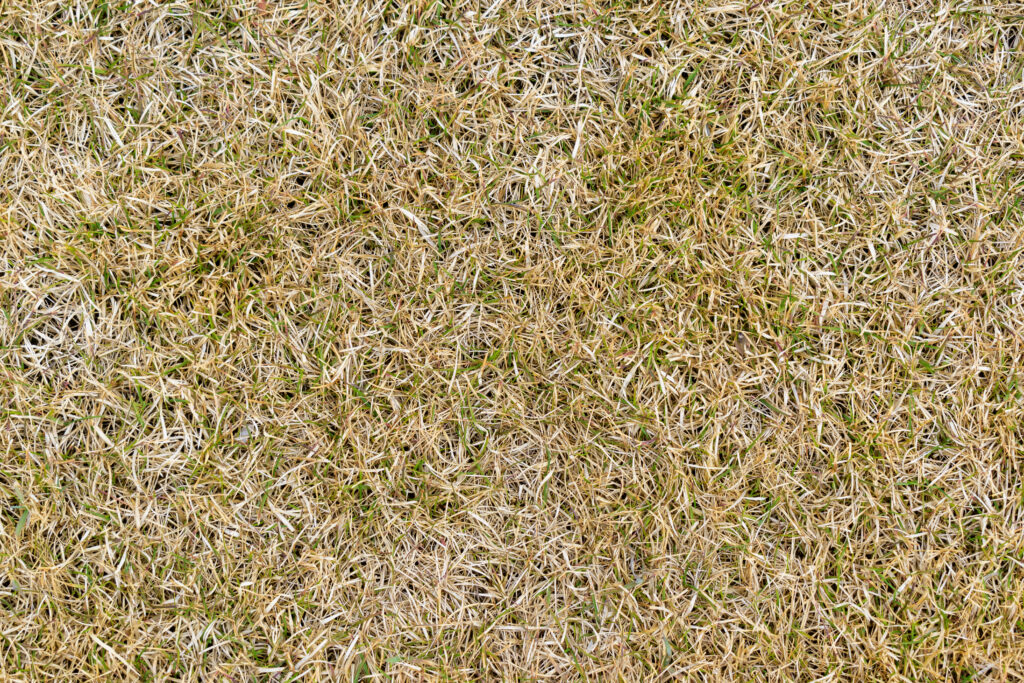
When grass growth all but stops in mid-summer, it’s frequently interpreted simply as a need for more Nitrogen. The grass looks pale, the mower box is not filling, and worn areas are taking longer to recover; we’ve applied copious amounts of irrigation water, so the natural conclusion is that the nutritional programme has failed. However, during a prolonged spell of high temperatures and low rainfall, that diagnosis might be a little simplistic, and it might be worth looking at some of the science behind what might be going on to help us understand the problem more fully.
A key factor in whether or not turf does well in prolonged heatwaves comes down to the process the plants use to manufacture their food…Photosynthesis. The bent, fescue, perennial rye and annual meadow grasses that do well in our climate are all adapted to grow most strongly in relatively cool conditions. The grasses we grow in the UK are cool-season plants, with two main growth periods occurring in spring and again in late summer/early autumn, when soil moisture is normally available, and temperatures are beneficial to both shoot and root growth.

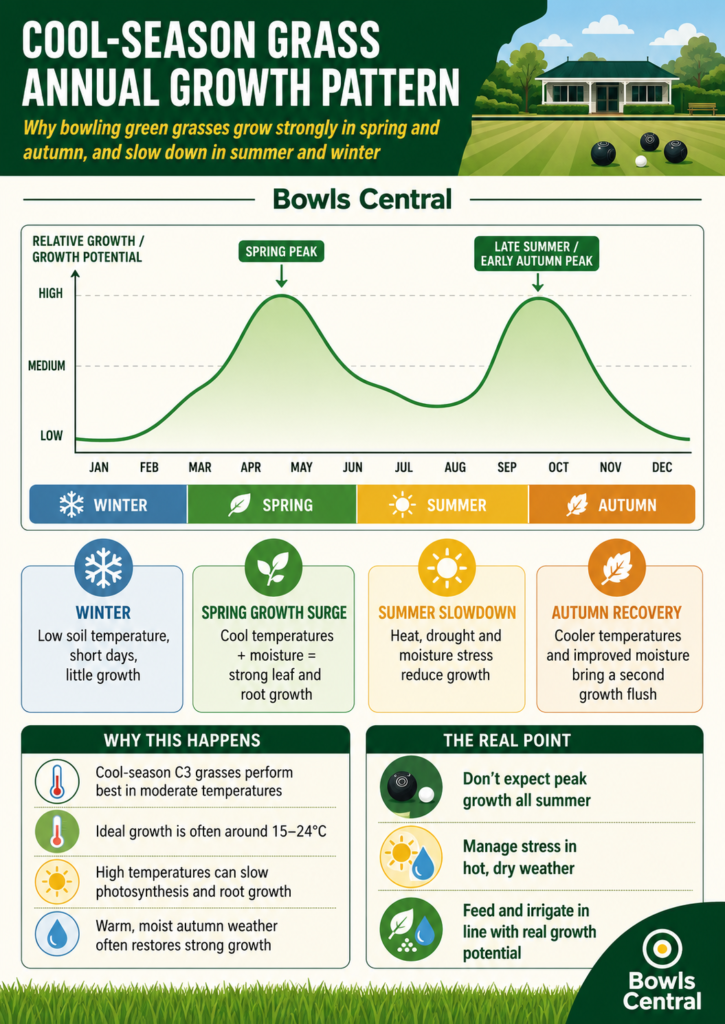
Even in an average year with a proper British summer, and by that I mean cooler and wetter, midsummer is not their most productive period. So, when daytime temperatures remain above 24°C for prolonged periods, particularly when nights also remain warm, growth can slow dramatically.
One question that has cropped up more than once recently goes something like this:
“How do greenkeepers in properly hot countries keep their greens looking so good and growing so well in the heat?”
The answer lies in Photosynthesis, so let’s take a closer look at what is going on with this miraculous physiological process when the weather is unusually hot and dry.
Photosynthesis
There’s a quick introduction here to Photosynthesis if you want a refresher, and a more in-depth look in the Bowls Central Academy, but very quickly, it is the process plants use to manufacture their food to produce energy to grow and multiply and follows this equation:
Carbon Dioxide + Water + Light —-> Sugar + Oxygen
In simple terms, this equation says that plants take in Carbon Dioxide from the air, along with the water taken up through the roots and the Sun’s energy, and use the process of Photosynthesis to manufacture Sugar to fuel their metabolism, then give off Oxygen as a by-product.
C3 and C4 Photosynthesis
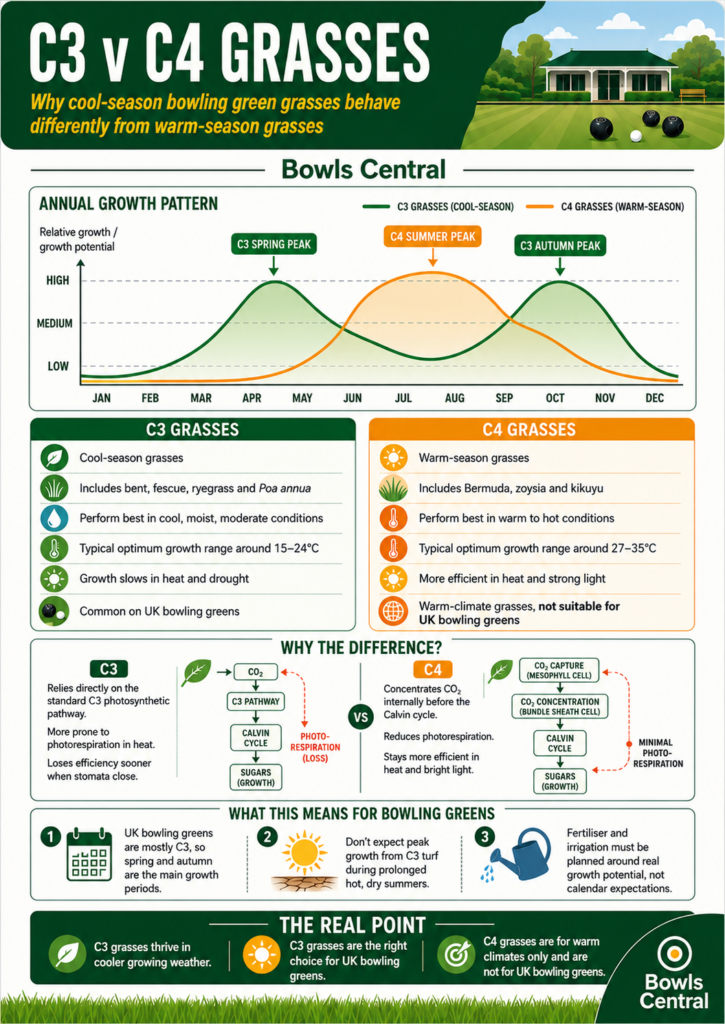
I mentioned already that our UK grasses are termed Cool Season Grasses and if you look a little deeper into turfgrass science, you will often see these referred to as C3 grasses. However, there are also C4 grasses…and, you guessed it, they are the Warm Season Grasses.
C3 and C4 describe two different ways plants photosynthesise. In our cool season (C3) grasses, carbon dioxide (CO2) enters the leaf through the stomata, the tiny pores in the outer skin of the leaf that open and close to facilitate gas exchange, water regulation, and temperature control. This CO2 is fixed directly by the enzyme Rubisco (or to use its slightly less catchy name: ribulose-1,5-bisphosphate carboxylase/oxygenase) into a three-carbon compound, hence the name C3.
This works efficiently in cool, moist conditions, but Rubisco becomes less selective as temperatures rise and begins reacting with oxygen instead of carbon dioxide. That process, known as photorespiration, wastes energy and releases some of the carbon the plant has already captured. When drought causes the stomata to close to preserve moisture, carbon dioxide inside the leaf falls even further, making photorespiration more likely and reducing the amount of sugar available for growth, rooting and recovery from the already stressful conditions that caused the stomata to close.
Warm Season (C4) grasses use an additional carbon-concentrating mechanism. They first capture carbon dioxide into a four-carbon compound and transport it to specialised cells where it is released at a much higher concentration around Rubisco. This largely suppresses photorespiration and allows the plant to continue photosynthesising efficiently in high temperatures, intense light and relatively dry conditions. The trade-off is that the C4 pathway requires extra energy and offers little advantage in cool climates. That is why C4 species dominate many tropical and subtropical grasslands and, of course, greens, while the C3 bentgrasses, fescues, ryegrasses and meadow grasses, adapted to cooler growing conditions, prevail here in the UK.
Air temperature is only part of the picture. The temperature within the turf canopy and the upper layer of a dry, exposed rootzone can be considerably higher than the temperature recorded at the nearest weather station. A bowling green sitting in full sun during a heatwave can become an unwelcoming environment for a cool-season grass plant.
As temperatures rise, respiration increases. The plant uses more of its stored carbohydrate reserves to maintain its living tissues. At the same time, photosynthesis becomes less efficient as we’ve seen already.
Where soil moisture is also limited, the grass begins to close the stomata on its leaves. These small openings regulate the movement of gases and water between the plant and the atmosphere. Closing them reduces water loss, but it also restricts the entry of carbon dioxide needed for photosynthesis, leading to increasing cycles of photorespiration. This means the plant is then caught between two competing demands. It needs to conserve water, but doing so reduces its ability to manufacture energy.
If the heat continues, the grass may begin using more energy through respiration than it can replace through photosynthesis. Root growth slows first, followed by tillering and leaf production. Older leaves may yellow as chlorophyll is broken down and resources are diverted towards the crown, where the plant’s essential growing points are protected. This yellowing can be mistaken for nitrogen deficiency. Applying more nitrogen may improve colour briefly in the least-stressed areas, but it does not correct the underlying energy and water deficit. The plant may have adequate nitrogen available and still be unable to use it effectively.
Root decline is particularly damaging. Cool-season grass roots generally prefer lower temperatures than the shoots. When the upper root zone remains hot for long periods, root growth slows, fine roots die back, and the effective rooting depth becomes shallower. This reduces the volume of soil from which the plant can extract water. Just as the atmosphere demands more water from the leaves, the root system becomes less capable of supplying it.
Annual meadow grass is especially vulnerable because it is often shallow rooted to begin with, but bentgrass and fescue are not immune. Their greater potential for deeper rooting only helps where the rootzone provides enough water, but as we’ve discussed in the previous articles in this series, the excessive amount of sand in some rootzones means that this can also be difficult to provide throughout a heatwave.
Dormancy
Our C3 cool-season grasses can become semi-dormant during prolonged heat and drought, slowing leaf and root growth, closing stomata and sacrificing colour to protect the crown until cooler temperatures and reliable moisture return. C4 warm-season grasses do almost the reverse: they thrive through summer heat but lose colour and enter winter dormancy as temperatures and day length fall. Their leaves turn straw-coloured while the crowns remain alive, ready to resume growth in spring.
This contrast is particularly obvious in the North American transition zone, where summers are sufficiently hot to favour C4 grasses. Still, winters are cold enough to make their dormancy long and sometimes damaging. Golf greenkeepers there often overseed dormant Bermuda grass with perennial ryegrass in autumn to provide a green, playable surface through winter. The ryegrass grows while the Bermuda is dormant. Still, spring then becomes a carefully managed handover, when the cool-season ryegrass must be weakened or removed as the Bermuda resumes growth; otherwise, it competes for light, water and nutrients. It delays the return of the permanent surface. It is an ingenious response to an awkward climate, but also a signal that greenkeepers there are skillfully managing two opposing seasonal grass systems on the same ground.
Can we use C4 grasses here?
Southern Europe contains Mediterranean turf transition areas where neither C3 nor C4 grasses provide perfect year-round performance. C4 turf copes better with the summer heat but becomes dormant in winter, while C3 turf retains winter colour but struggles through the hottest, driest months. Greenkeepers may therefore overseed dormant C4 surfaces with ryegrass for winter use, skillfully managing two opposing grass systems and then engineering the spring transition between them, but despite the extreme conditions we are seeing more regularly in the UK, we’re still a few generations away from a warm enough climate to sustain C4 grasses even for a month or two.
For the foreseeable future then, and probably well beyond the lifespan of even our youngest readers on Bowls Central we will need to manage our good old cool season grasses through increasingly stressful summers and that makes it all the more important to pay close attention to the needs of our grasses, the likely weather and climatic challenges we will face and work on our greens to prepare them to be more durable and more environmentally sustainable to upkeep.
Which leads us nicely into the urgent rootzone rethink needed to give our greens a fighting chance to get through the stresses of hot summers, and that’s where we’ll go next time. In the meantime, if you have any questions or need help with anything, feel free to drop me a line using the contact form.