


Unfortunately, many bowling greens now have root zones dominated by accumulated sand. Sand has been applied as a top dressing for decades in the belief that it would improve drainage and create a firmer, faster surface. In many cases, the result has been a shallow, drought-prone rootzone with limited capacity to store water and nutrients. A high-sand rootzone can contain large quantities of water immediately after irrigation yet retain relatively little of it within the plant-available range. Much of the water drains rapidly below the shallow root system or moves through preferential channels without wetting the rootzone uniformly.
Once hydrophobic conditions develop, the problem becomes more severe. Dry organic coatings around sand particles repel water, causing irrigation to run across the surface, concentrate in wetter channels or bypass the driest areas completely. The green can therefore receive what appears to be a substantial irrigation cycle while the roots within a localised dry patch remain almost untouched.
Sand also heats quickly. It has little of the buffering capacity provided by a properly-structured soil containing stable organic matter, humus and an active biological community. In dry weather, these sand-dominated profiles can become hot, hydrophobic and biologically subdued at precisely the time the plant needs the rootzone to function efficiently. This is one reason why watering high-sand greens through prolonged heat and drought is so difficult. The volume of water required is far greater than many people realise.
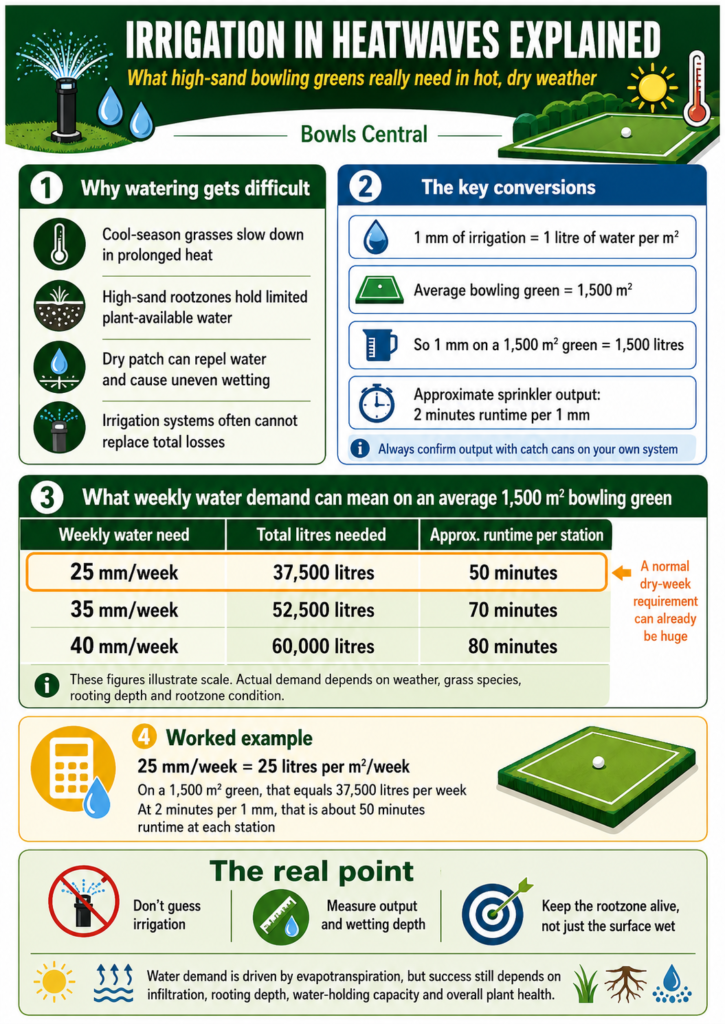
One millimetre of irrigation is equal to one litre of water per square metre. On an average 1500m² bowling green, every millimetre applied therefore requires 1,500 litres of water. A relatively normal dry summer week may require upwards of 25mm merely to keep pace with water lost through evapotranspiration. That equates to 37,500 litres across the green.
If the atmospheric demand rises to the equivalent of 35mm per week, the requirement becomes 52,500 litres. At 40mm, it reaches 60,000 litres. These figures do not mean that every green should automatically receive the full calculated evapotranspiration loss. The actual requirement depends on grass species, mowing height, rooting depth, shade, wind, humidity, soil moisture and the water-holding capacity of the rootzone. They do, however, demonstrate the scale of the problem.
Most bowling green irrigation systems are designed to provide occasional supplementary watering rather than to replace tens of thousands of litres every week through an extended drought. Tank capacity, mains refill rate, pump output and sprinkler efficiency all become limiting factors. A typical perimeter system with one sprinkler position on each side of the green may require roughly two minutes of operation at each position to apply an average depth of 1mm. The precise figure should always be established using catch cans, because the quoted output of the sprinkler is less important than what actually reaches the surface.
At two minutes per millimetre, applying 25mm would require around 50 minutes of operating time at every station. The tank then needs sufficient capacity or refill speed to supply that volume without any pressure falling. The pump must maintain the required output, and the sprinklers must achieve adequate overlap across the entire surface. Even where the average application is correct, distribution may be poor. Wind, worn nozzles, pressure differences, incorrect arcs and weak sprinkler overlap can leave one area receiving twice as much water as another.
An average of 25mm across the green is of little comfort if the most vulnerable areas receive only 12mm. This is why we can’t reduce irrigation management to simply turning the system on for a set number of minutes. The greenkeeper needs to know where the water is going, how deeply it is penetrating and whether the rootzone is retaining enough of it to sustain the plant.
Physical inspection of the soil is far more useful than relying on the appearance of the surface and definitely superior to relying on a cheap moisture meter.
Irrigation is generally best carried out overnight or in the early morning, when evaporation and wind losses are lower. Applying meaningful amounts less frequently is normally preferable to providing a token daily sprinkling that merely wets the leaf and upper surface. However, deep and infrequent shouldn’t become another inflexible rule. A rootzone containing more than 90 per cent sand, supporting a heat-damaged root system only a few centimetres deep, may be unable to store several days’ water.
Under those conditions, shorter intervals may be necessary. The important point is that each application should replenish the volume of soil occupied by active roots without producing excessive run-off, puddling or drainage below them. Cycle-and-soak irrigation can help in areas where water is running across the surface. Instead of applying the entire volume in one long cycle, the application is split into shorter periods with time between them for water to infiltrate.
Localised dry patch affected areas usually require separate hand-watering. Sprinklers naturally apply more water to areas that are already accepting it readily, while hydrophobic areas continue to resist wetting. These patches may need to be treated individually using an appropriate wetting strategy and a hose fitted with a suitable applicator.
Rainfall does not always solve the problem either. A short, intense thunderstorm can produce impressive figures in a rain gauge while supplying relatively little useful moisture to a dry, high-sand rootzone. Water may run off, pond temporarily, drain rapidly or travel through existing preferential channels. The total rainfall figure matters less than how much water enters the active rootzone and remains available to the plant.