


Nitrogen supports chlorophyll production, leaf growth, protein synthesis and recovery from wear. It is essential, but Nitrogen doesn’t create plant energy on its own. As we saw in a previous article in this series, the plant’s growth is controlled by its ability to produce energy during photosynthesis and our Cool Season Grasses aren’t ideally adapted to perform well in prolonged hot, dry weather. It follows then that our approach to maintenance also needs to adapt to the prevailing conditions.
Applying more Nitrogen when these conditions are absent doesn’t necessarily produce healthier growth. It may create a quick response in shaded, wetter or less-stressed areas, increasing the contrast between healthy and drought-affected turf. It can also encourage the plant to produce additional leaf tissue that its reduced root system cannot support. More leaf area means more potential water loss, greater mowing demand and a further call on carbohydrate reserves that may already be depleted.
This doesn’t mean that we can stop applying Nitrogen completely during summer. A plant under stress still requires nutrition to maintain chlorophyll, repair cell structures and preserve its ability to recover. The requirement is for controlled support rather than an attempt to force growth. Small, regular applications are generally more useful than large inputs designed to produce a dramatic flush. Slow-release and stabilised forms of Nitrogen can provide a background supply that becomes available as moisture, temperature and biological conditions allow.
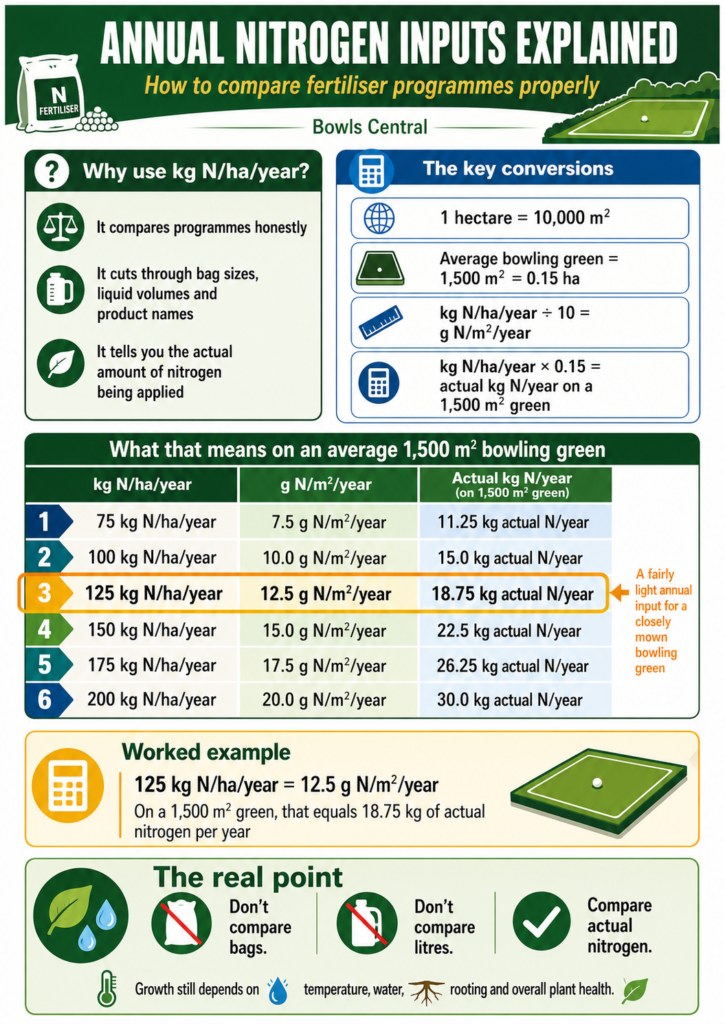
The distinction between annual nitrogen input and the timing of individual applications is important. A typical bowling green maintenance programme containing spring and autumn granular applications supported by small liquid applications through the growing season will supply between 125kg and 250kg of Nitrogen per hectare per year. The lower end of this scale, on a 1,500m² bowling green, equates to around 18.75kg of actual Nitrogen over the entire year, or approximately 12.5g of Nitrogen per square metre. In practical terms, this can be considered a fairly restrained input for a closely mown and regularly used sports surface. It is closer to the nitrogen philosophy traditionally associated with lower-input links turf than to an aggressive programme designed to produce constant lush growth on a parkland turf.
That annual figure is not intended to be a rigid ceiling. A green with good Soil structure, adequate moisture, strong rooting and a long active growing season may be capable of using more. A stressed, heavily sand-dominated green may be unable to use even that amount efficiently at certain times of year, especially when the turf is under stress from heat and drought.
Nitrogen demand is created by growth potential, which in turn is determined by temperature, light, water, grass species, rooting and Soil condition. The annual nitrogen total therefore needs to be viewed alongside the conditions in which it is being applied. A programme delivering 125kg N/ha/year can be entirely adequate, yet produce very little visible growth during a heatwave. The same programme may produce a strong response a few weeks later when temperatures fall, Soil moisture improves, and the plant’s carbon balance becomes positive again. A slow response is not evidence that the earlier application has failed. It reflects the fact that the plant has regained the capacity to use the nutrients that were already available.
There is a danger that we repeatedly add more Nitrogen because there has been no immediate response from the turf. When cooler weather and rainfall eventually return, the accumulated supply can become available all at once, producing excessive soft growth, increased mowing demand and greater disease susceptibility. It’s better to maintain a measured approach to fertilising while managing the environmental stresses that are actually limiting the plant’s ability to respond.
During prolonged heat, mowing height may need to be raised slightly. Verticutting, aggressive grooming and unnecessary surface disturbance should be reduced or suspended. Removing excessive healthy leaf tissue when photosynthesis is already restricted can be counterproductive to plant and turf health.
The mower box can often be removed in very dry conditions, allowing fine clippings to return a small amount of moisture and organic material to the surface. Irrigation should be directed towards maintaining crown and root survival rather than trying to manufacture summer growth that the plant is physiologically incapable of producing. The longer-term answer is to develop greens that are better equipped to survive these periods. That means improving the water-holding capacity of the rootzone, rebuilding stable organic matter, addressing hydrophobicity, supporting deeper rooting and reducing the continued accumulation of sand. It also means favouring perennial grasses capable of developing stronger root systems over the shallow-rooted annual meadow grass that has come to dominate many stressed greens.
Climate change is making the weaknesses of our existing rootzones more visible. Hotter summers, longer dry periods and more erratic rainfall are exposing the consequences of decades spent prioritising drainage above water retention and surface appearance above Soil function. The answer can’t be to apply more water to a rootzone that can’t hold it and more fertiliser to a plant that can’t use it.
A bowling green in a heatwave shouldn’t be judged by the quantity of grass collected in the mower box. Survival, density retention, crown health and the ability to recover when conditions improve are more meaningful measures. There will be periods when the green doesn’t grow strongly, regardless of how much fertiliser has been applied. That is not necessarily a management failure. It may be the entirely predictable response of a cool-season plant growing in hot Soil, under a dry atmosphere, with a limited root system and insufficient plant-available water.
Best practice greenkeeping recognises the physiological limits of the grass plant. Although we can usefully supply Nitrogen when required, improve irrigation and gradually rebuild the root zone, there’s nothing we can do to force a cool-season grass plant to behave as it would on a mild, moist day in May, whilst it’s dealing with a prolonged heatwave. Often the right response to a lack of growth is to get back to basics and just keep the grass alive until growing conditions improve.