


The current UK heatwave is placing bowling greens under considerable stress.
High temperatures, intense sunshine, drying winds and prolonged periods without useful rainfall are increasing water loss from both the grass plant and the soil. Greens that already suffer from excessive sand, hydrophobic soil or Localised Dry Patch are particularly vulnerable.
At times like this, the maintenance priorities have to change. We can’t continue unquestioningly with every operation shown on the annual maintenance programme. The immediate objective is simpler:
Keep the grass alive, protect the rootzone and avoid making the problem worse.
Stop verti-cutting for now.
Verti-cutting is commonly included in bowling-green maintenance programmes to control lateral growth, stand the grass up and help maintain a clean playing surface, which is very useful and effective in normal growing conditions.
During a heatwave, however, verti-cutting creates additional stress at precisely the wrong time. It cuts and can bruise leaf tissue, disturbs the surface and increases the exposure of the soil beneath the canopy. That can accelerate moisture loss and leave already stressed plants with more tissue to repair.
If your green is drying rapidly, showing signs of wilt or developing Localised Dry Patch, stop verti-cutting until cooler conditions and reliable soil moisture return.
Pause pencil-tine aeration
The same principle applies to routine pencil-tine aeration. Aeration is normally an essential part of good greenkeeping. Roots and beneficial soil organisms require oxygen, and regular aeration helps maintain a functioning rootzone, but the timing of these jobs is important.
In very hot, dry conditions, thousands of open pencil-tine holes can increase the surface area through which moisture is lost. On a dry, sandy or hydrophobic green, those channels may encourage further drying rather than deliver the usual aeration benefit.
Pencil tining can also break the limited continuity of moisture surrounding shallow roots. For the duration of the heatwave, it is sensible to pause routine pencil-tine operations. Aeration can resume once moisture levels have recovered sufficiently.
Light Sarrel rolling is still useful.
A light pass with a Sarrel roller is different. The shallow pricking action doesn’t open the root zone as aggressively as pencil tining, but it can help water penetrate through a sealed or water-repellent surface. This is valuable where irrigation is running off, sitting temporarily on the surface or failing to wet dried-out areas evenly.
The purpose is to create small entry points through the immediate surface so that irrigation water and a natural wetting agent such as BioActive Yucca have a better chance of reaching and wetting the soil in the root zone.
Irrigate deeply, not daily
Irrigation scheduling is now one of the most important decisions you will make. A few minutes of irrigation every day may temporarily darken the surface, but it often fails to apply enough water to reach the active root zone.
Frequent shallow watering causes much of the water to be lost from the upper surface to evaporation before the plants can make effective use of it. The objective should be to apply enough water to wet the rootzone properly.
Where practical, irrigate during the late evening or overnight. Evaporation losses will usually be much lower than during the heat of the day, allowing a greater proportion of the applied water to reach the soil.
Do not assume that because the irrigation system has completed its cycle, the green has received enough water. Use a soil sampler to help establish how deeply the water has penetrated. A wet-looking surface can still be dry only a few millimetres below.
On very dry or hydrophobic soils, water may need to be applied in two or three shorter cycles separated by soaking periods. This allows the first application to begin wetting the surface before subsequent applications carry moisture deeper into the profile.
The principle remains the same: apply a useful volume of water, rather than repeatedly dampening just the surface.
Sprinklers aren’t of much use against Localised Dry Patch.
Automatic sprinklers are useful for keeping general moisture across the green, but they are rarely precise enough to correct established Localised Dry Patch. Distribution is seldom perfectly uniform. Wind affects coverage, sprinkler arcs overlap unevenly, and the driest areas are often repelling water before it can enter the soil.
Where individual patches are dry, hand water them by removing the spray fitting from the hose and using the open end to apply a slow, concentrated flow directly to the affected area. The aim is to build sufficient water pressure and volume at the surface to encourage moisture into the soil beneath.
Apply BioActive Yucca first, lightly Sarrel roll where necessary, and then water the area thoroughly.
For more persistent fungal dry patch and difficult rewetting, Aquastasis can provide a more intensive corrective approach.
Take the grass box off.
Another simple but effective change is to mow with the grass box removed. In dry conditions, allowing the fine clippings to return to the surface can provide a modest mulching effect. The clippings contain moisture and nutrients, and they help shade the immediate soil surface from direct sunlight.
On a frequently mown bowling green, the amount removed at each cut should be small enough to disperse into the turf without leaving an untidy layer.
Adjust the mowing regime.
The grass plant needs leaf area to photosynthesise. When it is already under heat and moisture stress, excessively close or frequent mowing removes part of the plant’s energy-producing surface and reduces its ability to recover.
Consider raising the height of cut slightly and reducing mowing frequency where playing commitments permit. A small increase in leaf area can improve shading of the soil, support deeper rooting and reduce the severity of moisture stress. Sharp mower blades are also essential. A clean cut loses less moisture and creates less plant stress than a torn, ragged leaf.
Be careful with fertiliser.
Heat-stressed turf won’t benefit from a heavy application of conventional, salt-based fertiliser. Granular fertilisers applied to a dry surface can increase osmotic stress around the roots and may scorch the turf if they are not watered in thoroughly.
Equally, a completely starved plant has fewer resources with which to maintain itself and recover. Where nutrition is required, a modest application of a low-salt, slow-release liquid nitrogen source such as Liquid N 28-0-0 is generally more appropriate than forcing growth with a heavy granular application.
Support the biology.
Heat and drought do not only affect the grass plant. They also affect the biological processes responsible for nutrient cycling, organic-matter decomposition, root development and soil aggregation.
The new Biology Bundle delivers a practical way to introduce and support beneficial biology without the complication of brewing traditional compost tea. Used as part of a wider soil-health programme, biological inputs can help improve rootzone function and plant hardiness.
But no biological product can compensate for a rootzone that has been allowed to dry beyond the point at which organisms and roots can function. Biology requires moisture.
The order of priorities is therefore clear:
- Restore adequate soil moisture.
- Keep the plant alive.
- Avoid unnecessary mechanical stress.
- Support biological recovery and plant durability.
Heat exacerbates the problems with too much sand.
The most important lesson from this heatwave may not be about irrigation at all. It may be about the rootzone we have created.
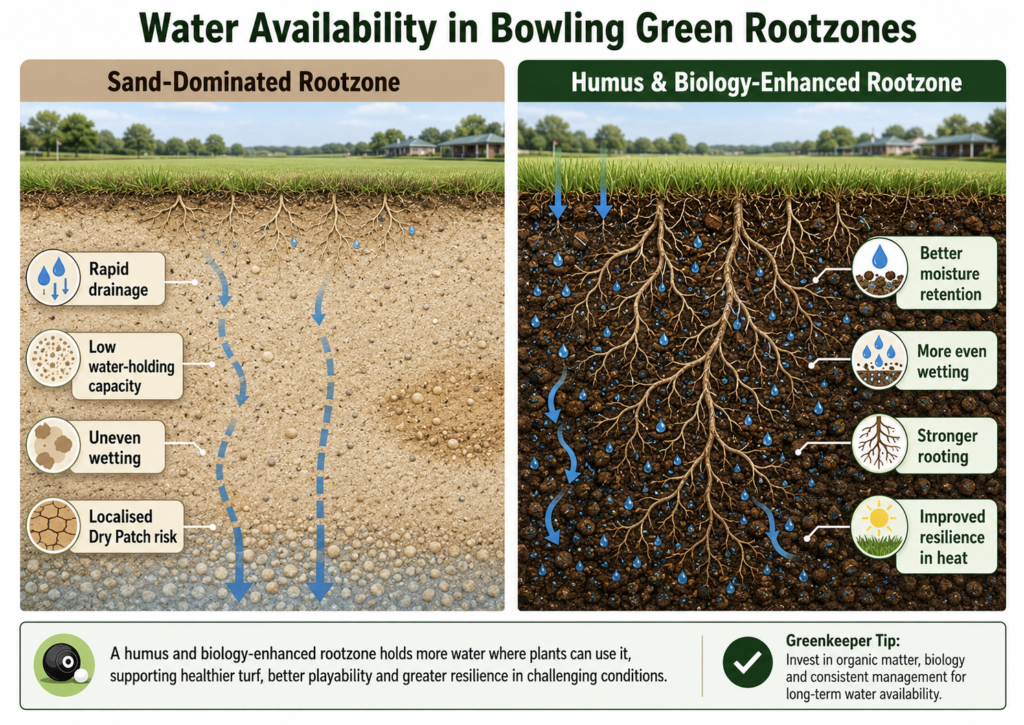
Many bowling greens have received annual applications of sand-dominated top-dressing for several decades. The result is often a surface rootzone containing far more sand than a healthy natural soil would ever contain. Sand has very little capacity to retain plant-available water or nutrients. It likewise contributes little to the biological buffering that helps a living soil cope with environmental extremes.
Where organic coatings form around sand particles, the root zone can become hydrophobic. Water then follows preferential channels through some parts of the green while refusing to enter others. This is why one area can be saturated while another, only a few metres away, remains powder dry. It is also why applying more sand this autumn will not cure the underlying problem.
The first two articles in this series explain this in more detail:
Climate Change Challenges for Greenkeepers – Part 1: The 50/50 Top-Dressing Trap
Climate Challenges for Greenkeepers – Part 2: Stop Adding Sand to Bowling Greens
Heatwaves are becoming a more important test of bowling-green resilience. A biologically active soil containing stable organic matter and a balanced mineral fraction will generally buffer heat, retain moisture and recover more effectively than an inert, excessively sandy construction.
The heatwave checklist
For the duration of the current hot, dry spell:
- Stop verti-cutting.
- Pause pencil-tine aeration.
- Use only light Sarrel rolling where it helps irrigation penetrate.
- Irrigate deeply rather than applying token amounts every day.
- Water during the cooler hours whenever possible.
- Check the depth of water penetration.
- Hand water localised dry patches with the open end of the hose.
- Use Yucca and Aquastasis to help rewet hydrophobic soil.
- Mow with the grass box removed where clippings disperse cleanly.
- Consider raising the height of cut slightly.
- Avoid heavy, high salt fertiliser applications.
Use your maintenance programme as a guide and make sensible adjustments as you go depending on green condition and the weather.
For now, keep disturbance to a minimum, use water intelligently and help the green survive. There will be time to restore, refine and renovate once the heat has passed.