


Why repeatedly adding more sand can perpetuate the surface problems clubs are trying to cure
A persistent idea I see repeated in bowling greenkeeping is that low areas can gradually be corrected by applying a little extra top dressing each year. Not necessarily all at once. Just slowly adding topdressing to dips, and eventually the surface will come back up to the perfect level. It sounds perfectly reasonable. The difficulty is that both the mathematics and the turf’s structure work against it.
Imagine a low area covering around 650 m², something commonly found where a green slopes gently toward an edge, averaging perhaps 8 mm below the green’s general level over the area. To physically replace that missing volume of soil would require:
650 m² × 0.008 m = 5.2 m³
At a representative bulk density of around 1.8 tonnes/m³ for a sandy 70/30 dressing, that equates to 9.4 tonnes of material
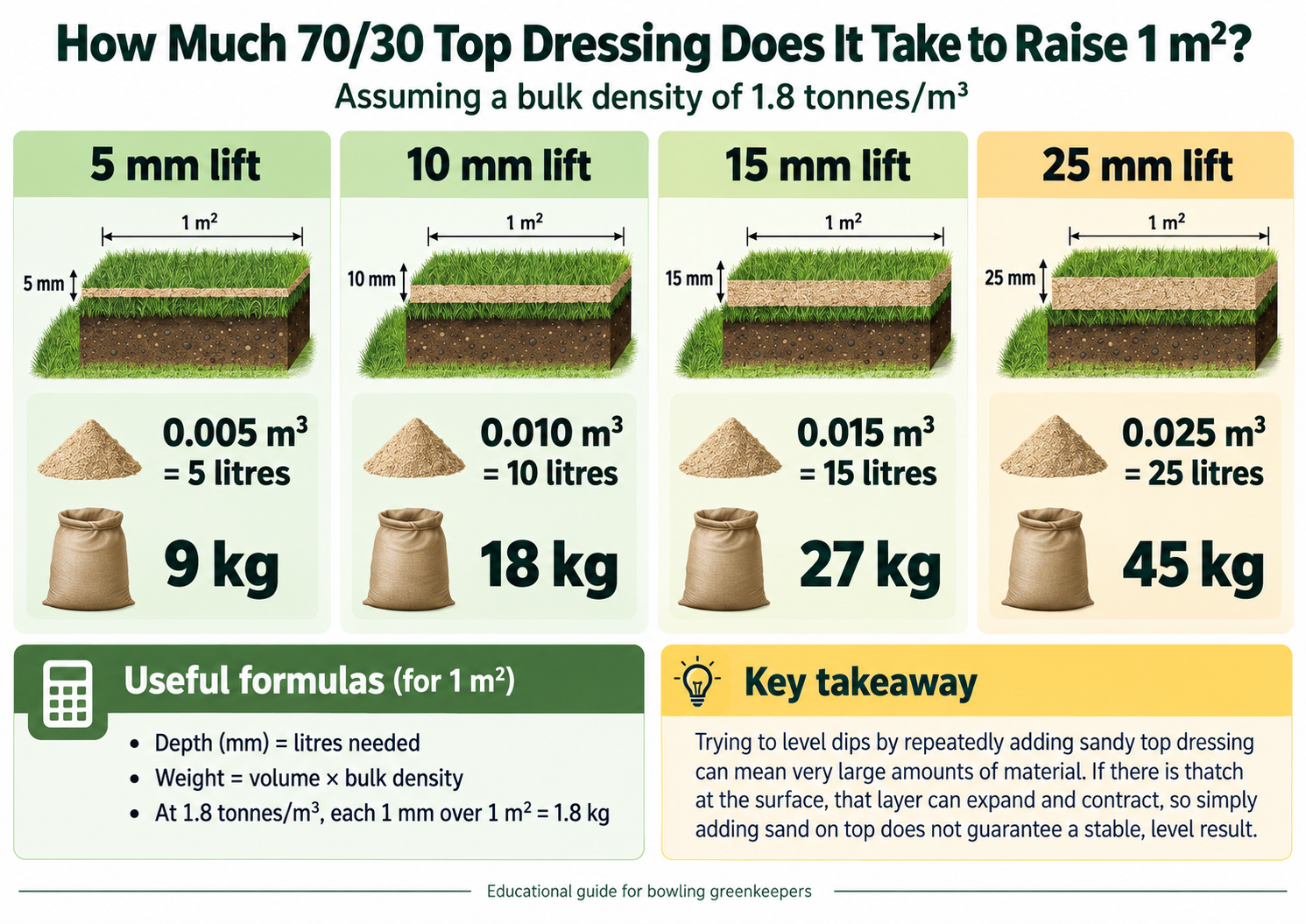
Of course, no one would attempt to apply over nine tonnes to the area in one go, but it simply illustrates the scale of the problem. Even if that theoretical correction were spread over several seasons, the volume requirement doesn’t reduce. If you genuinely want to raise 650 m² by 8 mm, you have to incorporate about 5.2 cubic metres of additional material somehow.
However, this thinking is somewhat flawed, because it assumes the 8mm dip will wait around to be filled in the first place. This overlooks one big important fact.
The green is a living entity, not an engineered surface.
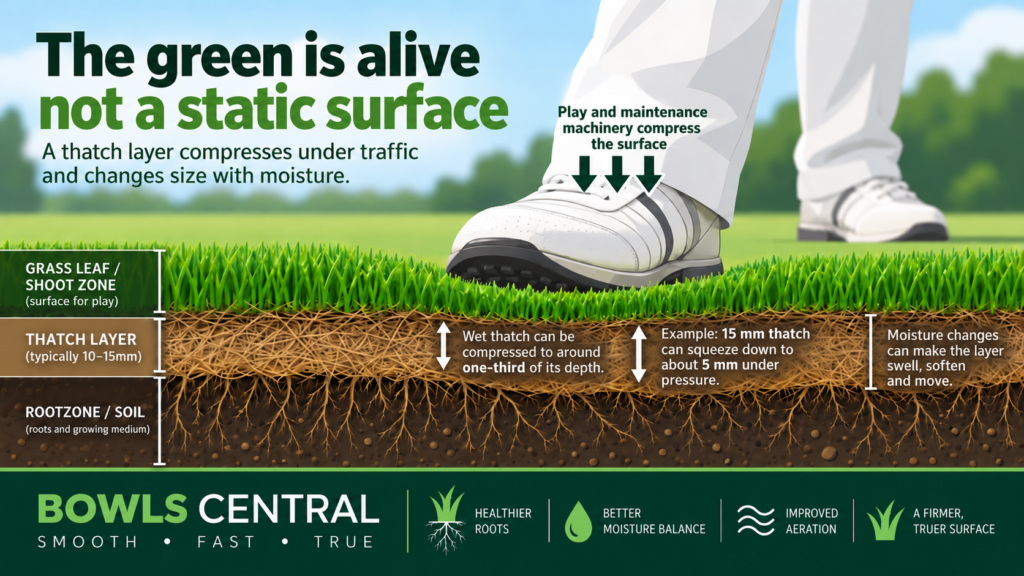
A bowling green is not a stable, engineered surface that can be levelled permanently. It is a living, breathing ecosystem. Immediately beneath the playing surface there is a layer of roots, stems, and partially decomposed organic material known as thatch. The thatch layer’s dimensions change with moisture. It softens and swells when wet, and contracts as it dries. It compresses underfoot during play and under the weight of maintenance machinery, and responds continuously to biological activity, humidity, the season, and the weather.
Take a substantial piece of wet thatch in your hand and squeeze it, and the extent of that compressibility becomes very obvious. A 15 mm sample can readily be squeezed down to around 5mm. This means that, depending on the green condition, the layer immediately under the surface is often unstable. So what happens when we place another layer of sandy dressing on top? We haven’t eliminated that movement; we have simply buried it under a layer of sand. Sand and thatch often combine into a dried-out, dense mat, which is a major contributor to Localised Dry Patch. And this is the fundamental weakness in the argument that repeated top dressing will eventually manufacture a permanently level surface.
A few millimetres represent a lot of material
Even apparently minor level changes involve surprisingly large volumes of soil. Consider a typical 1,500 m² bowling green. A theoretical 1 mm layer across that area requires 1.5 m³ of material. At 1.8 tonnes/m³, that is about 2.7 tonnes of top dressing. If we extrapolate from that:
2 mm = 5.4 tonnes of material
3 mm = 8.1 tonnes
4 mm = 10.8 tonnes
If you have ever applied ten tonnes of dressing to a bowling green, you know that this is a very substantial quantity of material to work into the surface. It doesn’t incorporate into the surface as easily as expected. Some of it works into the turf canopy easily, but beyond that it starts to smother out areas of turf that then become compromised, susceptible to disease and unable to perform normally.
Many greens already contain far too much sand
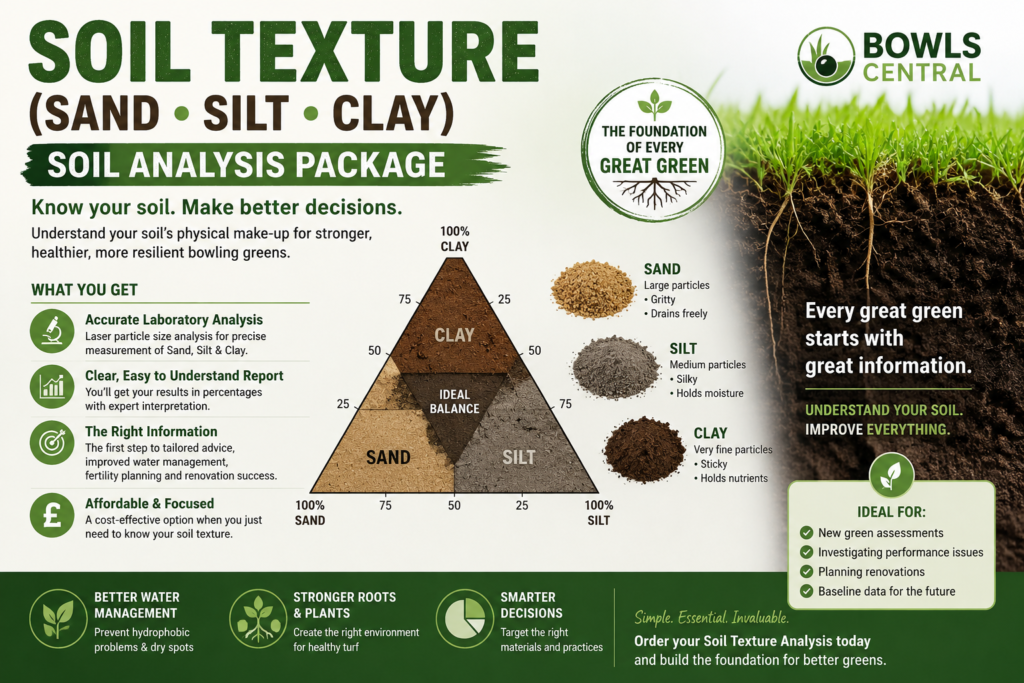
This is where the conventional thinking becomes particularly difficult to justify. Many bowling greens have received sandy dressings annually for decades. When their soil texture is analysed, sand percentages over 90% are common. At the same time, those greens may suffer from Localised Dry Patch, uneven wetting, excessive thatch build-up, low organic matter content, and everything that comes with that. Repeatedly adding highly sandy material may be contributing to the instability, drying, and turf loss that produce further surface irregularity.
The surface problem may not be a shortage of material
Before attempting to build up any substantial low area, the first question should be: “What is actually causing the level difference?” Is it genuine settlement in the underlying soil, or a constantly expanding and contracting thatch layer?
The better logic behind the Not-Dressing programme
There is another important point that conventional renovation often overlooks. Many greens already contain enormous quantities of previously applied sand top-dressing.
Scarifying, grooving, and hollow tining can bring that material back toward the surface while reducing thatch, improving gas exchange, and creating physical space within the rootzone. We can then redistribute that recovered material, mixed with materials designed to improve the soil environment rather than simply increase sand content. Materials such as LeoZeo, Humigranule, and BioActive RZ can add useful physical, chemical, and biological properties, while the renovation process itself tackles the thatch and structure responsible for much of the instability.
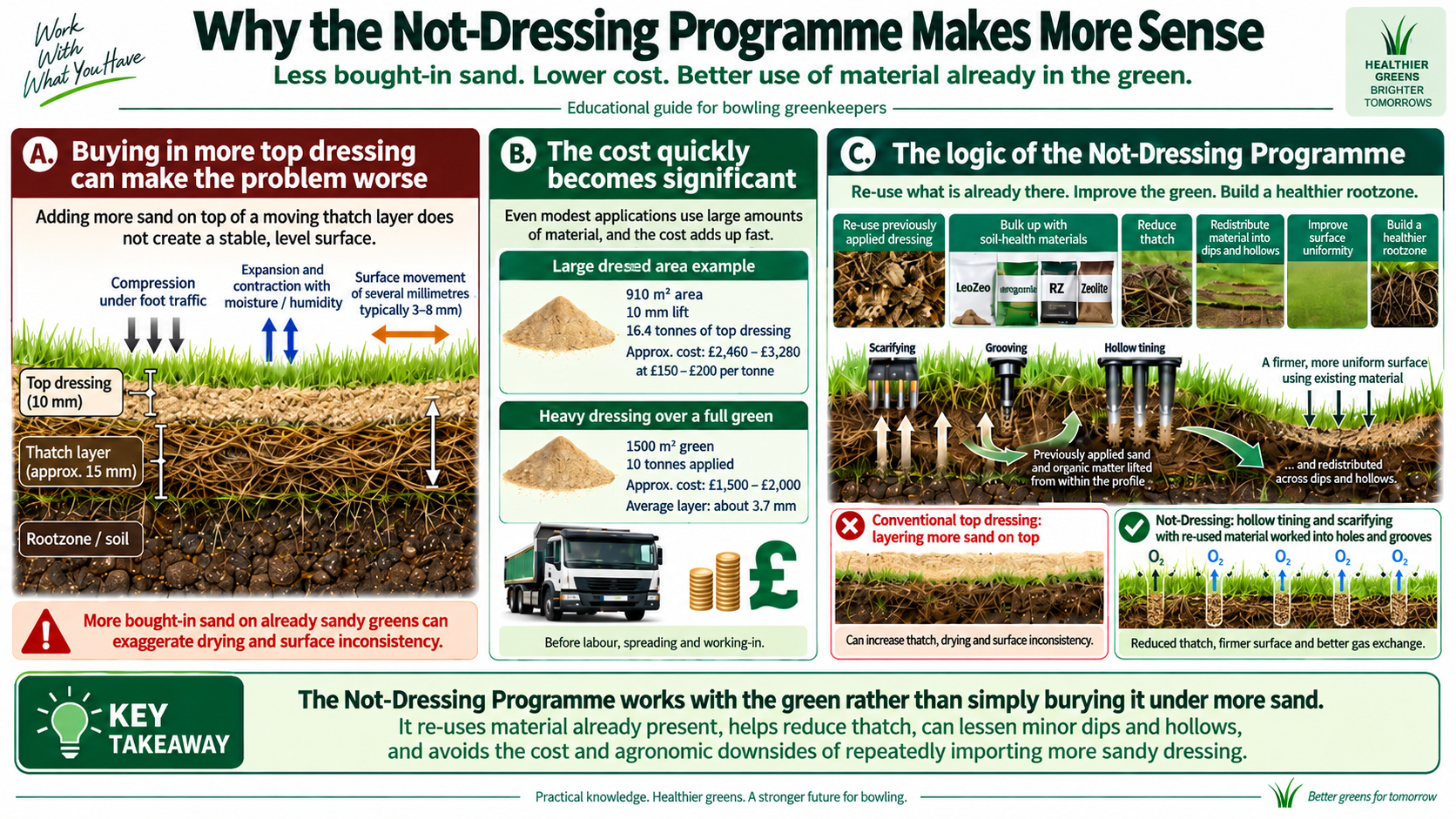
Conventional top dressing repeatedly adds more layers of mostly sand. Not-Dressing attempts to rework and improve the existing soil profile.
Sometimes a significant structural depression may require lifting the turf and properly correcting the underlying level. But the automatic assumption that bumps and hollows can be progressively dressed away deserves much greater scrutiny. A bowling green grows, dries, wets, compresses, expands and responds to traffic every day. It is a living system.
With that in mind, repeatedly placing more sandy material on top of a moving organic layer becomes a much less convincing route to permanent surface uniformity. Before ordering another load of dressing, look beneath the grass. The material you need may already be there. And the real problem may not be a shortage of sand at all.
Recommended products
-

Academy Membership (1 Year)
£306.48 -
Peak Sand (Texture Analysis only)
£59.97 -

Peak Sand Autumn Renovation Pack
£903.30

