


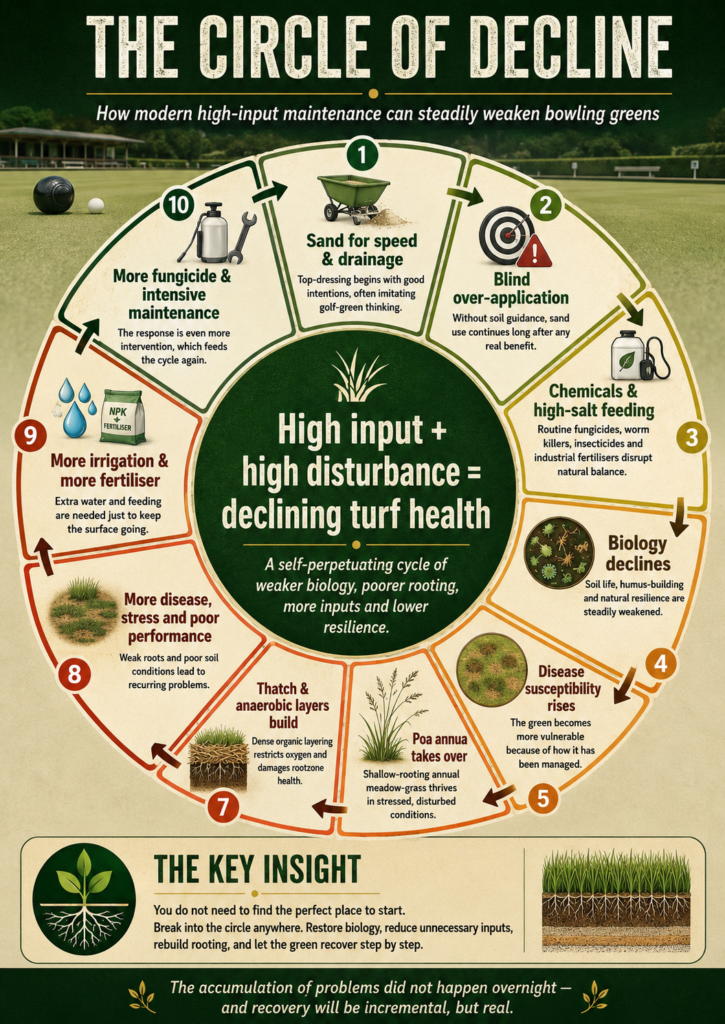
There is a familiar pattern in bowling green maintenance. A club spends money every year. It top-dresses, aerates, fertilises, irrigates, treats disease, hires machinery and follows a programme. Everyone is trying to do the right thing, yet the green never really improves. The surface stays weak, disease returns year after year, localised dry patch gets worse, Poa annua spreads, thatch builds. Root mass and depth decrease, and the green needs more water, fertiliser, and increasingly aggressive spraying to produce a playable surface.
This is what I call The Circle of Decline, a self-perpetuating cycle where the maintenance used to solve a problem gradually becomes the reason the problem keeps coming back. Most bowling greens did not decline through neglect. They declined through well-intentioned but misguided greenkeeping.
How the circle of decline begins
For many clubs, the story starts in the 1970s and 1980s. Bowling greens were often heavier soil constructions. They held water, played slowly and could be difficult to manage. Performance demands were increasing. Then the sport started taking note of green performance developments in golf, particularly the USGA Specification for green construction, an excellent, yet hugely misunderstood set of rules for controlling the cost of building golf greens that perform close to true links green standards.
Estimates of how well this goal has been achieved vary widely, with marks for firmness and playability scoring around 90%, down to 60% for biological maturity compared to a links green. However, due to the requirement to absorb and easily recall quite a lot of fairly technical soil science and physics to understand how to build a USGA specification green fully, it has, over the years, become increasingly distilled by many to “it’s very sandy”. The sand bit gets memorised; the technical specification of the sand and other materials is largely overlooked.
So, the thinking that developed was simple enough. Golf greens were fast and firm and were built mainly of sand. Therefore, bowling greens needed more sand. There was some truth in it. Hollow-tining and dressing with sand could improve heavy, poorly drained soils. In the right circumstances, and for a time, it made sense. The trouble is that much of this work was done blind. Clubs didn’t know the existing soil texture or how much sand was already present in their rootzones. Therefore, they had no way of knowing when to stop…so they carried on.
A little sand helped, so more sand must help more was the way the thinking went. What began as a short-term plan to correct the performance of the rootzone became a habit, resulting today in greens that routinely test at 90% or more sand in the rootzone. That is one of the great hidden problems in bowling green maintenance today. A club can keep applying sand for decades, long after any benefit has passed, because the operation still looks and feels like good greenkeeping and, of course, the green used to improve every time we did this in the past.
However, soil does not improve endlessly by adding more of the same material. There is a point I’ve described as Peak Sand, where the rootzone stops becoming better and starts becoming too sandy, drought-prone and biologically weak; there’s no life left in the soil.
Many UK greens passed the point of Peak Sand some years ago.
The wider damage
As a result of the excessive sand in rootzones, bowls had to adopt more of the high-input greenkeeping thinking from golf and amenity turf.
Routine fungicides, worm killers and insecticides were now needed to counter the effects of pests and diseases that could now run amok with no natural checks and balances in the soil to keep them at sensible thresholds. High-salt mineral fertilisers, chemical wetting agents, and excessive irrigation were now needed to get the grass moving in the absence of the natural systems that work in the soil to recycle plant material and form relationships with perennial grasses to help them thrive. This led to a need for more aggressive renovation and greater intervention in general.
Each input had a reason and could be explained, of course. Disease had to be stopped, worm casts had to be controlled, growth had to be pushed, but the combined effect was a steady weakening of the soil-plant system. The soil biology declined, meaning that humus building in the soil slowed down, roots receded, and thatch accumulated. The fine, perennial grasses struggled in this environment. Poa annua found the conditions it likes: shallow, fertile, wet at the surface, frequently disturbed and biologically out of balance.
Once Poa annua takes over, the green becomes even more demanding. Poa is shallow-rooting, stress-prone and disease-prone. It produces thatch readily. It needs more water in dry weather and more feeding to keep it looking acceptable. It gives quick responses but little resilience.
So the club feeds it, waters it, treats the disease, manages the thatch, applies more dressing, opens the surface again and waits for improvement.
But the improvement never quite arrives, because the system being maintained is the same system that created the weakness.
That is the Circle of Decline.
What happens in nature when humans don’t interfere?
Let’s stop here for a moment to consider what happens in nature, because this is what we are trying to work with…I emphasise work with, as we can’t try to bend nature to our whims without consequences, especially when some of our instruments of choice are blunt (fungicides, for example), to say the least. There is a useful lesson in the science of natural plant succession that can help us build a greater understanding of what we, as greenkeepers, are ultimately trying to do:
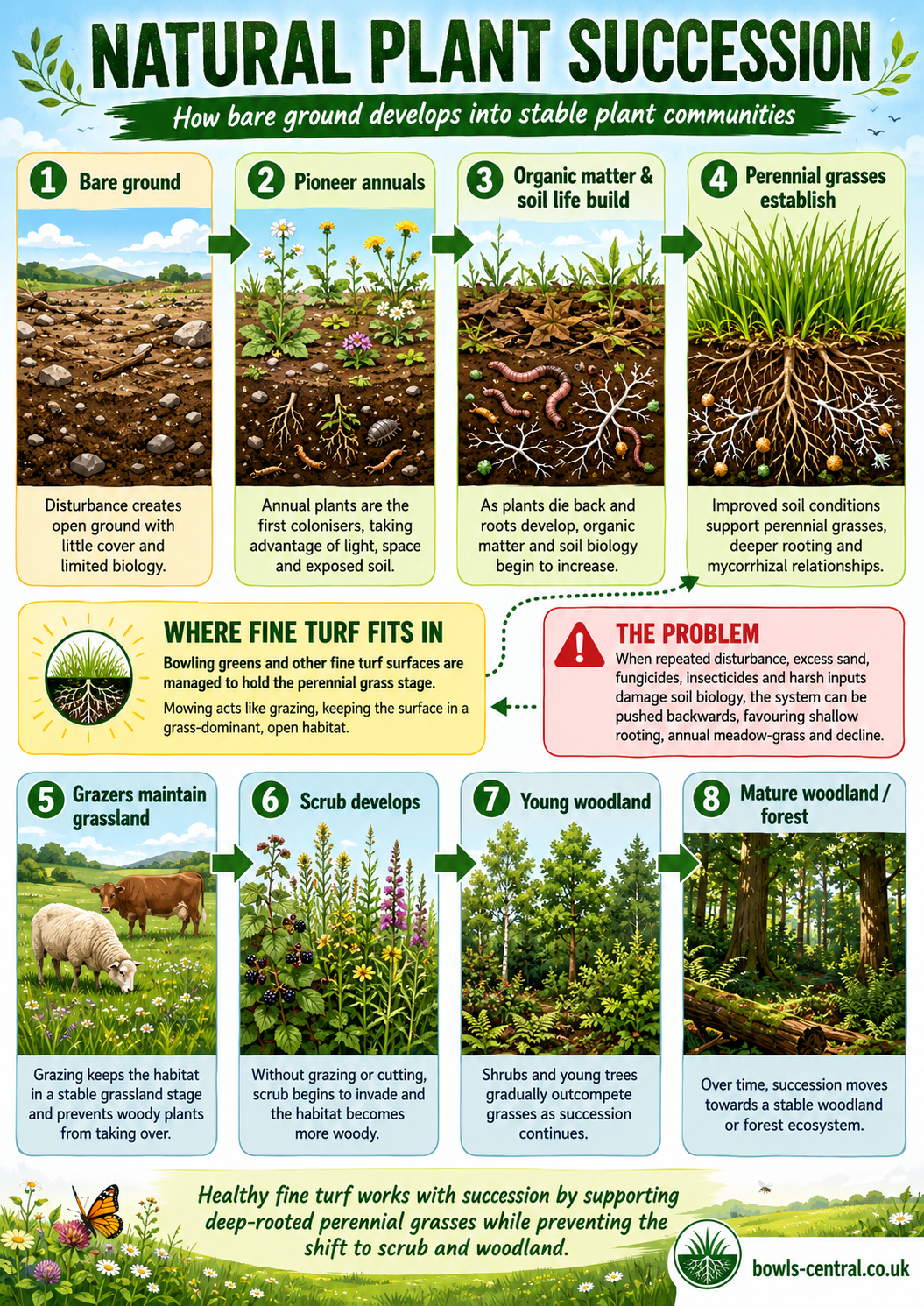
Natural Plant Succession
Annual weeds first colonise bare ground, and their growth and decomposition slowly build humus.
Humus allows soil biology to build, leading to mycorrhizal fungi and deeper rooting, perennial grasses.
Left alone for long enough, that process keeps evolving towards scrub and eventually woodland.
Fine turf sits in the perennial grass stage. Our job is to act like the grazers, to maintain the system at the perennial grass-dominant stage of development.
The irony is that much of our modern greenkeeping has done the opposite.
Fungicides, insecticides, worm suppression, industrial fertilisers, excess sand and repeated disturbance weaken the actual soil life that supports perennial grasses.
Instead of holding the green in a stable, perennial grassland state, we keep bashing it over the head, sending it backwards towards the conditions favoured by opportunistic annuals like Poa annua and the inevitable Circle of Decline.
Thatch, disease and weak rooting
A small amount of organic material at the green surface is normal. Excess thatch is different. It is undecomposed material building faster than the soil biology can process. It holds water in winter, repels water in summer, restricts oxygen, encourages disease and interferes with rooting. Thatch is one of the clearest signs that the turf/soil ecosystem isn’t healthy.
The result is often a puzzle at first. The same green can hold water after heavy rain and suffer from localised dry patches in dry weather. That seems confusing until you understand the layers. Water sits in the wrong place, roots stop in the wrong place, air movement is restricted, and the plant becomes increasingly dependent on surface moisture and artificial feeding.
This is why disease pressure rises. It is not simply bad luck or bad weather. Weather triggers disease, but weak plants and poor soil conditions invite it.
A green with shallow roots, excess thatch, poor air movement and soft growth will always be vulnerable. Fungicide can suppress an outbreak, but it does not correct the condition that allowed the outbreak to develop. In many cases, repeated fungicide use pushes the green further away from the biological balance it needs and the decline continues.
Hot Summers and Sunk Costs
As someone who grew up in the 1970’s, I can easily put my finger on the great summers we have had in my lifetime…up to a point. Who can forget 1976 when we all burned up through the summer holidays? And 1995 now seems like a stupid year for me to try to build a golf course in one of the driest regions of the country, and it was tough work, but we didn’t know what summer would be like from one year to the next. However, since the mid 90’s, choosing your best summer has all become a bit of a Blur, sometimes with no Oasis in sight :-). I have now lost count of the summers like 76 and 95, because they have become all too regular, and as we’ve seen more recently, this is now starting to hit home hard for those of us trying to maintain greens.
The most difficult part of this conversation is that clubs have by now spent a lot of money creating a problem, and the increasingly hot and dry summers we are seeing mean there’s a long-overdue discussion about getting over sunk costs. It’s uncomfortable, but it matters.
If a club has been top-dressing for forty years, it is hard to accept that much of that work may now be holding the green back. Nobody wants to hear that past expenditure might have been misdirected. Or tell the committee that the annual renovation budget has helped build a rootzone that is now too sandy, too dry and too weak, so the habit continues.
Another renovation involving adding another few tonnes of sand, because it’s what we’ve always done, beckons. This is classic sunk-cost thinking. The more time, money and belief invested in a process, the harder it becomes to stop, even when the results are clear that we should.
Greenkeeping has to be judged by outcomes, not traditions, and if a green is already beyond Peak Sand, adding more sand because it is September is not a programme; it’s a ritual.
Symptoms.
Sand is applied to improve drainage and speed. Without knowledge of the soil’s current texture and structure, sand applications continue blindly and for far too long. The rootzone becomes more drought-prone and biologically weak. Routine fungicide applications are made to fend off the inevitable disease outbreaks, killing critically low populations of beneficial soil fungi in the process. More high-salt fertilisers are needed to get a reaction from the weak turf sward, but they also reduce natural resilience by introducing high levels of mineral salt. Fescue and bent lose ground, Poa annua takes over and goes about its speciality…building a thatch layer. Thatch restricts oxygen, which lowers pH, holds water and increases disease pressure. Disease leads to more fungicide. Shallow roots lead to more irrigation. Poor response leads to more fertiliser. More inputs create more weakness.
Round it goes. The club remains busy. Money is spent. Work is done. The green may even be nursed through each season, but the direction is wrong. The programme is treating symptoms while protecting the causes.
Breaking into the circle
The first step is to stop looking for the perfect starting point. A circle has no obvious beginning. That is what makes it feel difficult. Do we start with sand? Thatch? Soil biology? Disease? Nutrition? Irrigation? Aeration? Poa? Localised dry patch?
The answer is simpler than it appears. Start anywhere that stops the problem from getting worse.
Stop unthinkingly applying sand top-dressing until the soil texture is known. Reduce routine chemical use where the risk allows. Move away from harsh, high-salt feeding. Improve oxygen in the rootzone. Maintain microbial activity. Rebuild humus. Encourage rooting. Use water more intelligently. Create conditions where better grasses have a chance.
The order matters less than the direction. Every decision should be tested against one question: does this make the green more dependent, or less dependent?
A good maintenance decision should move the green towards deeper roots, stronger biology, better soil structure and lower stress…for the grass plant and the greenkeeper. A poor one may create a short-term improvement while increasing chronic dependency.
Recovery
The opposite of decline is not a miracle cure or quick fix, but a better curated maintenance and renovation programme.
Reduce the habits that created the problem, test the soil, observe the green by getting yourself a soil sampler and getting your hands dirty ( I am still perplexed by how few bowling greenkeepers have a soil sampler or ever look under the turf to see what is going on!) Build your knowledge of what is actually happening in the soil. Ease back from unnecessary chemicals and aggressive inputs; feed and encourage the rebuilding of beneficial soil biology. Work on rebuilding humus and soil health. Increase oxygen and rooting. Encourage finer grasses. Reduce disease pressure. Decrease dependency on constant water and fertiliser.
As the soil-plant system improves, the green starts to help itself. Better biology supports better rooting, which reduces stress, which reduces disease, which negates the need for fungicide. Better moisture management reduces irrigation dependency. Balanced nutrition reduces soft growth. Healthier conditions give fescue and bent a better chance against Poa annua.
That is the Circle of Recovery. It is not dramatic at first. It does not arrive in one renovation week. It is built by consistent decisions that all point in the same direction.
The decline took years, sometimes decades, to build. Recovery will be incremental, but incremental doesn’t mean insignificant.
A green that roots better, wets more evenly, suffers less disease, needs fewer emergency inputs and produces a firmer, more reliable surface is already moving in the right direction.
Autumn Questions
Before any maintenance operation, ask this:
Are we breaking the Circle of Decline, or perpetuating it?
That one question cuts through a lot of tradition. It contests the automatic need for a top-dressing programme, the routine spraying of pesticides, excessive applications of cheap, industrial fertilisers, and the assumption that more work always means better greenkeeping.
The aim is not to do less for the sake of it, but to make every job count. Bowling greens improve when the soil starts functioning again, when root mass and depth increase and when thatch is brought back under control.
The Circle of Decline is real, but it doesn’t have to be permanent. The moment a club stops defending the old system and starts making soil-first decisions, the recovery has already begun.
Here to help
As always, if you need a hand, drop me a line using the contact form