
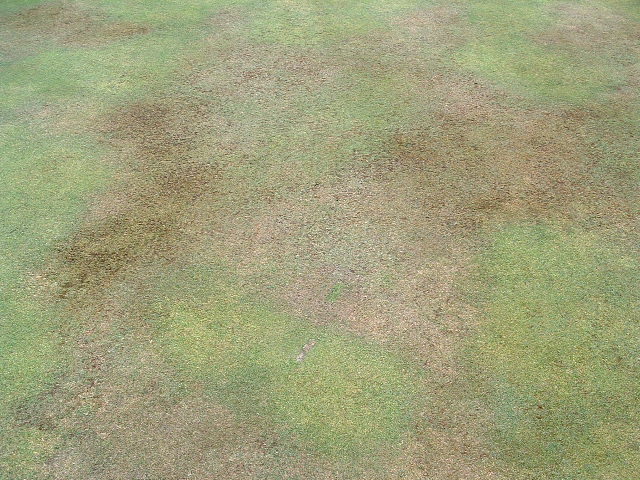
Across the UK this summer, bowling greens have been baked in the intense summer heat. Weeks of hot, dry weather have left surfaces bare, cracked, and rock-hard. For many clubs, the underlying soil has crossed into a more serious condition — hydrophobicity — where the soil physically repels water, a phenomenon identified as Localised Dry Patch.
It’s important to address this ahead of attempting any autumn renovation works
You can’t wait until your usual mid-September renovation programme to put things right, as a successful renovation will be difficult if not impossible with greens in their current state.
Prepare for Success
The Autumn Renovation programme will work best when there is moisture in the soil and the turf is actively growing, so it can withstand the rigours of scarifying and intensive aeration; and, of course, for successful overseeding, evenly moist soil is essential.
If the green is still hydrophobic and bone dry in September, aerators can break up the surface, and tines can bounce on hard, dry turf instead of cleanly penetrating the soil.
When overseeding, it’s not unusual to get almost 100% germination with quality seed, only to find that many of the newly emerged seedlings wilt and die due to lack of soil moisture after they’ve exhausted their seed case food reserves.
LDP Recovery
Greens suffering from Localised Dry Patch or severe drought stress can take a while to turn around, so the coming weeks can be used as an important pre-renovation preparation period to improve soil moisture before tackling the autumn renovation.
The work needed includes
- Gently breaking through the hydrophobic layer with a sorrell roller or shallow mini tines to allow for better infiltration of water.
- Gradually restoring the soil’s ability to accept and hold water.
- Rehydrating the root zone with hand-held hose soaking, so that the turf can start to recover ahead of autumn.
AquaStasis + BioActive Yucca
This is where AquaStasis and BioActive Yucca come into their own, used together in an intensive recovery programme that has already been a saving grace for many clubs this year.
- AquaStasis produces protease enzymes that target and break down the waxy, water-repelling proteins that cause Localised Dry Patch. This means water can finally adhere to soil particles again.
More on AquaStasis → - BioActive Yucca is a fully natural, certified organic wetting agent and biostimulant. It improves water infiltration, helps moisture spread evenly through the soil profile, and supports microbial ecosystems to aid long-term recovery.
More on BioActive Yucca →
The Recovery Programme
Recommended programme of work you can start today:
- Tine the surface to open the soil. You may have to go gently with this, or start by hand-pricking with a fork.
- Apply AquaStasis (750g in at least 70 litres of water per green application) with BioActive Yucca.
- Pre-dilute AquaStasis in water before adding to your sprayer.
- Apply in two passes at right angles for full coverage.
- Repeat weekly or as spot treatments, with frequent hand soaking using a hose to push water into the root zone.
You’ll see results fastest where the surface is regularly soaked after treatment. AquaStasis needs moisture to work. Don’t rely on the sprinklers; they can’t deliver enough targeted water to LDP-affected areas.
Is this the New Normal?
This summer’s weather isn’t a one-off.
Extreme heatwaves and prolonged dry spells are now a regular part of the UK bowling calendar. The old model of throwing more sand on the green every year, hoping things will even out, is not just outdated; it’s actively making drought recovery harder.
I’ve written extensively on why unthinkingly adding sand is a dangerous long-term trap:
Full application guide included with AquaStasis (look in your account area for the download after purchase, or drop a line to John)