
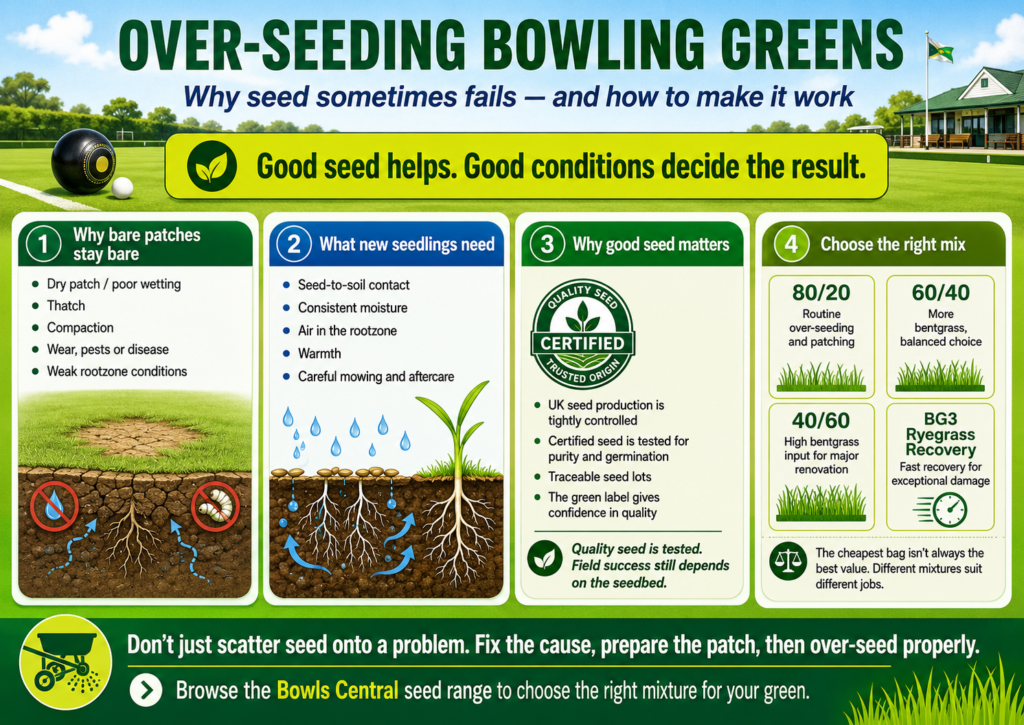
Grass seed gets blamed for a remarkable number of problems it didn’t cause. Every year, clubs buy good-quality seed, sow it over the green or into bare patches, and then wait for the transformation. When the improvement fails to appear, the usual conclusion is that the seed didn’t germinate, the mixture was poor, or the whole exercise was a waste of money. Sometimes seed can be mishandled, stored badly or allowed to deteriorate, but with fresh, professionally produced grass seed from a reputable supplier, there is usually a more important question to answer:
Why was the area bare in the first place?
A patch of grass rarely disappears without a reason. It might have been lost through Localised Dry Patch, excessive thatch, compaction, poor water infiltration, disease, leatherjacket damage, wear, shade or a combination of underlying problems. Whatever the cause, simply sowing more seed into it won’t remove the underlying causes of bare soil.
If the soil can’t supply enough water, air and nutrition to sustain the mature grass that was already growing there, it is unlikely to provide a hospitable environment for a tiny new seedling. Repeatedly throwing seed at an untreated bare patch simply means paying several times for the same failure.
Seedbed Preparation
Grass seed contains the potential to produce a new plant, but it can’t repair hydrophobic soil, reduce thatch, relieve compaction or restore a moisture or nutrient-depleted root zone. A dry patch must be thoroughly re-wetted before seeding. Water running off the surface or passing around the edges of the affected area won’t help. The water needs to penetrate evenly into the soil where the new roots will be expected to grow.
Thick thatch must be reduced and opened up. Compacted soil needs aeration. A badly damaged area may need to be broken up and prepared by hand to create a proper seedbed. Where leatherjackets, disease or physical damage have removed the turf, the cause and the wider condition of the green must be considered before restoration work begins. This is particularly important when repairing isolated bare patches. A handful of seed scattered over a hard, dry or thatchy surface has very little chance. Prepare the patch properly, loosen the surface, remove dead material, correct any water repellency and give the seed direct contact with soil.
The seed can then do the job it was produced to do.
Germination and establishment
We often see strong lines of young grass emerging seven to fourteen days after over-seeding, and it can be easy to assume the work has been successful. At that stage, the seedling is still drawing heavily on the energy reserves inside the seed case. The real test begins when those reserves run down, and the young plant has to obtain water, oxygen, light and nutrition through its own newly developing roots and leaves.
The seedling is entering an established plant community. Mature grasses already have extensive root systems and immediate access to available moisture and nutrients. Annual meadow grass and other opportunistic plants are especially effective at occupying open spaces. New seedlings are also competing with one another, especially where seed has been applied too heavily.
Strong initial germination can therefore be followed by heavy losses during establishment. The seed might have germinated as planned and expected, but the seedlings simply didn’t survive.
Close mowing, surface traffic, water stress, poor rootzone conditions and competition from the existing sward can all reduce the number of seedlings that eventually become permanent members of the green. This is why the apparent success seen shortly after sowing can be a poor guide to the long-term result.
Seed Quality
The professional grass seed industry in the UK is tightly regulated. Seed crops are grown under regulated conditions, inspected for varietal purity and checked for contamination. After harvesting, the seed is carefully dried, cleaned and separated from chaff, soil, weed seed and other unwanted material. Individual seed lots are then tested for purity and germination by official or licensed seed-testing stations.
Only seed that satisfies the required standards can proceed through the certification system and be marketed as certified seed. Seed merchants must be registered, keep full records and maintain traceability through the seed-lot reference number.
Professional amenity seed mixtures are supplied with the familiar statutory Green Label. Packages over 10kg carry an official green mixture label, while qualifying smaller packages carry the corresponding supplier’s green label. The label identifies the mixture, supplier or packer, weight and traceable seed-lot information. The components used in the mixture must have achieved the relevant statutory purity and germination standards.
That green label tells you that the contents haven’t simply been scooped from an anonymous bulk supply and put into a bag. There is a regulated production, testing and record-keeping system behind it.
It also helps to separate seed quality from field performance. The certification process shows that the seed lot was capable of meeting defined germination and purity standards within regulated testing conditions.
Timing
Early autumn usually provides the best opportunity for over-seeding a bowling green. There should still be useful warmth in the soil, while the renovation work has temporarily reduced the strength and density of the existing sward. Scarification removes dead material, opens the surface and weakens some of the established competition. Accurate seeding then places the new seed into the spaces that have been created. The aim is to give the seedlings enough time to develop roots and become established before winter growth slows significantly.
Spring sowing can produce rapid germination when moisture and temperature are favourable, but the young seedlings must then compete with the vigorous spring growth of the mature sward. They are also exposed much sooner to regular mowing, preparation work and bowling traffic.
Calendar dates alone aren’t enough. Soil temperature, moisture availability and the condition of the green matter more than the date printed on the renovation plan. Sowing into cold, saturated soil because “we always seed this week” makes little sense. Neither does sowing during dry weather when reliable irrigation isn’t available.
Get the seed into the soil
Broadcasting seed across the surface and hoping rain will complete the job is unreliable. A proper over-seeding or dimple-seeding machine creates shallow openings and places the seed accurately into contact with the soil. This improves moisture access and reduces losses to wind, birds, surface runoff and machinery.
Heavy sand dressing isn’t required for seed to grow. It can bury fine seed too deeply and add more sand to root zones that may already be excessively sandy. Accurate placement, good contact and steady moisture are far more important.
Bare areas can be prepared by hand. Remove loose and dead material, break up the surface, correct any dry patch and create a fine, firm seedbed. Very large bare areas may need more substantial renovation, turfing or plugging rather than another light scattering of seed.
Moisture must then remain consistent during germination and early establishment. Allowing the seedbed to dry out after germination can kill the emerging plant before a visible shoot has developed.
The surface needs moisture, but it also needs air. Constantly saturating the area can encourage disease, reduce oxygen around the developing roots and increase the risk of damping off.
Choosing the right seed mixture
The cheapest bag per kilogram isn’t necessarily the best value. Bowling green mixtures are usually built around fine fescues and browntop bentgrasses. The percentages shown on the bag are percentages by weight, and bent seed is dramatically smaller than fescue seed. A mixture containing a higher percentage of bent therefore contains far more individual seeds.
Using approximate seed counts, one kilogram of an 80/20 fescue and bent mixture may contain around 2.4 million seeds. A kilogram of 40/60 may contain around 6.2 million. The higher-bent mixture costs more per kilogram, but it contains nearly three times as many potential plants and a much larger population of the species intended to form the long-term fine-turf sward.
The practical choices within the Bowls Central range are:
- Premium 80/20 Fescue/Bent is a cost-efficient pick for routine autumn over-seeding and patching where relatively quick visual cover is important. A typical over-seeding rate is around 20g per square metre.
- Premium 60/40 Fescue/Bent provides a stronger bentgrass contribution while retaining useful early establishment from the fescues. A typical rate is around 15g per square metre.
- Premium 40/60 Fescue/Bent supplies the greatest bentgrass population and is particularly suited to major renovation, badly depleted fine-turf swards and projects where long-term bent development is the priority. Its much higher seed count allows a typical rate of around 10g per square metre.
- BG3 Premium Ryegrass Recovery Mix is available for exceptional recovery situations where severe damage has created a need for very rapid cover. Ryegrass can be useful in an emergency, although I wouldn’t normally choose it as the foundation of a long-term high-performance bowling green.
The Bowls Central Premium fescue and bent mixtures use highly rated cultivars and are produced by a respected independent UK seed house. They are also supplied with a mycorrhizal seed coating to support early establishment. Cultivars may occasionally be replaced according to availability, but only with equivalent or higher-rated selections.
Sowing Rates
Applying more seed doesn’t automatically produce more grass. Excessive sowing rates increase competition between the new seedlings. They can also create a dense, humid canopy that is more vulnerable to damping off and other establishment problems. Fine bent seed is especially easy to overapply because such a small volume contains an enormous number of individual seeds.
Always calibrate the machine before a new overseeding job. It’s best to apply the seed in at least two directions, so divide the total seed into two or more applications and work in different directions to improve distribution. Keep enough seed back to hand-sow on very weak areas rather than repeatedly overlapping the whole green.
The correct rate depends on the mixture and the general condition of the sward, but each mixture in the Bowls Central shop includes sowing rates for over-seeding work.
Fertiliser
New seedlings need access to nutrition, but that doesn’t justify automatically applying a fertiliser as soon as the seed is sown.
Many established bowling greens already contain adequate or excessive phosphorus. Additional applications should be based on soil analysis, the condition of the green and the actual requirements of the establishment programme. A gentle, moderate approach is usually safer than trying to force rapid growth. The objective is steady root and shoot development, followed by gradual unification into the existing sward.
Timing of autumn fertiliser applications is important. If you can time the application to just about when the seed is expected to have germinated and then exhausted the seed case reserves, this should hit the sweet spot for providing extra nutrition ot the young plants
Early establishment period
Over-seeding shouldn’t end when the seed leaves the machine. The green must be monitored for moisture, emergence and early growth. Mowing should resume with a sharp, correctly set cylinder before the established grass becomes excessively long, but the cutting height and frequency must avoid repeatedly removing too much from the new seedlings.
Traffic and maintenance work should be managed carefully. Seedlings that have only just produced their first leaves can be uprooted or crushed very easily.
The result also needs to be judged over months rather than days. Germination tells you that the seed was alive. Establishment tells you whether your preparation and aftercare worked. Changes to the permanent composition of the sward take longer again.
Get the best results
Over-seeding remains one of the most useful ways to introduce better grasses, improve density and gradually influence the species composition of a bowling green. It works best when it forms part of a wider improvement programme based on soil condition, moisture management, thatch control, aeration and sensible nutrition.
Used properly, good seed can produce an enormous number of potential new plants for a relatively modest investment. Scattered onto an untreated dry patch, it becomes expensive bird food. Before ordering seed, decide what you want the new grass to achieve. Consider the current species, the condition of the rootzone, the severity of the damage, and the amount of preparation that can realistically be carried out. You can then choose the mixture for the job rather than buying whichever bag appears cheapest.
The full Bowls Central range includes options for routine over-seeding, increased bentgrass introduction, major renovation and rapid emergency recovery. Academy members also receive their usual member pricing and delivery benefits.