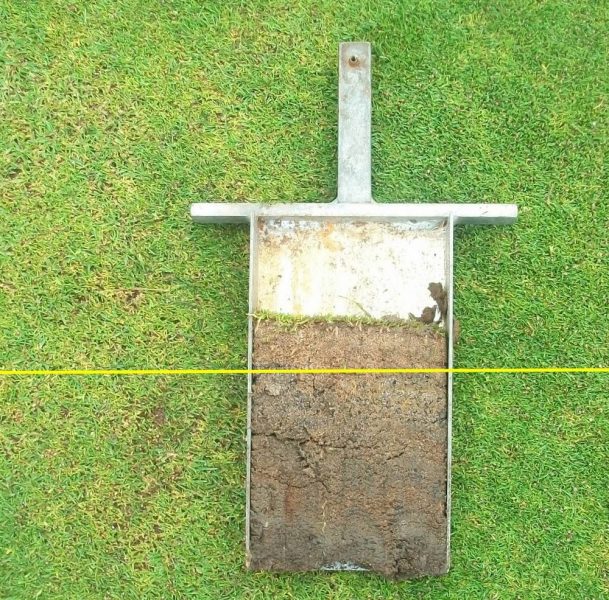
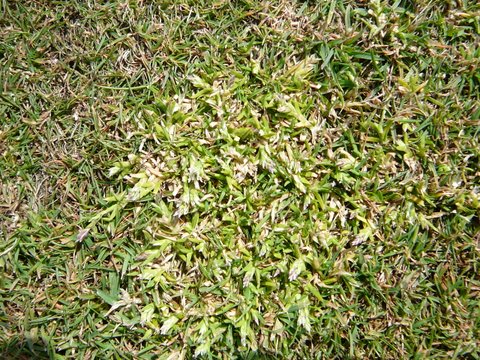
The sward on the majority of UK bowling greens consists of 3 main grass types; various bent grasses (Agrostis), various Fescues (Festuca) and Annual Meadow Grass (Poa annua). Of these, the bent grasses and annual meadow grass are prolific thatch producers.
Thatch consists of dead and dying roots, shoots, leaves, stolons and rhizomes and in comparison to a completely natural setting, it builds up remarkably quickly on fine turf such as bowling greens. This is due to a few factors that are unique to sports surfaces, mainly related to their use and maintenance. Chief among these factors is compaction as we saw yesterday.
Some thatch is good and in fact essential to maintaining the integrity of the surface, but if a layer builds up beyond that (thicker than about 8mm) it can really start to cause big problems.
Doug has adapted his rotary mower to save a lot of back breaking work
Straight after my request for guest posts/articles Doug Smith shares this labour saving idea for light aeration of the green. This follows on from Rob’s recent post on hand fork aeration. I’ll let Doug do the talking now:
Hi John, I have been reading your advice on green Aeration, the one on using a fork, I too have used a fork to
do the job, but only for a short time, I found it took far to long, and very hard work, so I gave it some thought,
and adapted my lawn mower, [see photo,] I use it on my home lawn, twice a month, and on the Bowls green.
hope this is of some use to your readers.
Regards Doug Smith
Thanks very much Doug for sharing this with us and hopefully it will be the first of many from readers in the coming months.
I had an interesting conversation with a bowling club official last night that focussed mainly, not on the green for a change, but the club turnaround process that she hopes to take her club through starting soon. Yesterdays post of course, emphasised the urgency of getting started on any project of this nature in the middle of the bowling season; so it was quite fortuitous that this was fresh in my mind, because she asked me a direct question which went some thing like this:
“John. If you were to lead the turnaround of my club, what would you do first and then how would the project pan out after that?”
She was looking for a step by step plan of course that she could apply to her situation.
My answer was emphatic, clear…and mercenary:
Step 1: buy my eBook: Bowling Club Survival and Turnaround; its under a tenner if you are a member of the Bowls Club Mastermind Network and it spells out in 7 easy steps what to do and exactly how to do it.
I was then slightly embarrassed when she said she already had the eBook and that she had read it cover to cover, several times and had made copious notes and was absolutely 100% convinced that it contained the answer to her club’s problems.
The trouble is that she is still having trouble getting what she called “buy in” from the rest of the committee of the club.
“They just can’t accept that decades of slippage, accompanied by the most unpredictable recession in a century, the smoking ban, the cost of living, the general reduction in interest in bowling etc etc could possibly be turned around, let alone by some eBook or other!”
BINGO! I said, that’s it! They are absolutely correct; it can’t be!
Confused looks ensued!
You see my eBook is a series of thoughts, of ideas, of recommendations of which I am convinced, but an eBook alone cannot possibly help your club to get out of its current mess and secure a bright future.
So Step 3 is to implement what you have read in the eBook and that means ACTION!
Step 2 by the way, in case you are wondering, is NOT to tell anyone that you have a new eBook by some geezer on the internet that is going to work miracles for the club!
And that is because it is the enthusiasm of a leader like you; a leader who steps up in a time of crisis, a leader armed with the correct plan and convinced that success is only a bit of blood, sweat and tears away that turns clubs around.
Concentrate on minimising lateral grass growth for greater speed and smoothness.
OK, so this is probably a bit late for this year, but keep a note of it for future reference.
This has been a popular question on the site.
The readers who searched on variations of this theme were essentially asking, “What can be done immediately before a game to improve the playing surface?”
Green speed is hampered by excessive thatch build up, which saps some of the momentum of the bowl, so although there isn’t much that can be done about this 5 minutes before the match starts, making thatch reduction and control a major part of the maintenance strategy will help a great deal.
The other major problem in achieving speed is the control of lateral grass growth on the green. This is when grass grows along the ground instead of straight up. The grass plants develop this tendency in order to avoid damage from the mower blades. It’s an evolutionary process; the grass plants that grow this way survive to create more vegetative growth.
So we want to discourage this habit and promote survival of the more upright plants.
To do this we can employ regular grooming, brushing and verti-cutting.
Using the groomer set to 1.5mm above cutting height for the cut immediately before the game will help a lot with this. The groomer attachment on your mower is designed to tease up lateral growth just prior to being cut by the cylinder.
If you don’t have a groomer on your mower you can usually fit a static brush just behind the front roller and this can also do a good job of teasing lateral growth to the upright position prior to cutting if set properly.
Regular verti-cutting will slice through the lateral growth and tease up blades that would otherwise not be cut properly
Annual Meadow Grass takes over worn heads (photo by S Kennerley)
The rink heads on the bowling green are subject to higher levels of wear and tear than any other playable part of the green.
The concentration of foot traffic on these areas causes severe compaction of the soil resulting in poor growth characteristics and in many cases invasion by annual meadow grass. Due to the shallow rooting of this grass the heads can quickly become skinned and badly worn with little grass cover. I’ve uploaded a new Worn Heads Factsheet to the Mastermind Network area detailing what you can do to minimise and prevent wear and how to properly renovate heads so that they don’t keep wearing out.