
At some stage in any ongoing issue, the evidence becomes so clear that it can no longer be ignored. Many of the bowling clubs that contact me seeking advice on improving green performance have now reached that stage with sand. Having experienced another summer with high temperatures, weak turf, hydrophobic dry patches, disease, bumpy surfaces, restrictions on irrigation and rising renovation costs, the question can no longer be:
What autumn dressing are we going to have?
It needs to change to:
Why are we continuing to add more sand to a green that is already suffering from an excess of sand?
Over the past 20 years at Bowls Central, I have worked with hundreds of UK bowling clubs, and it is easy to see a recurring pattern. The greens that are suffering most from Localised Dry Patch, poor recovery, weak rooting, inconsistent surfaces, excessive thatch, winter disease problems, and summer drought stress are always the same ones that have, for decades, been regularly dressed with sand-based materials, regardless of the soil conditions below.
In many instances, this procedure is carried out every year simply because that is what the club has always done; perhaps it originated because someone at one time stated that top dressing was essential, or that the green looks considerably better immediately after the autumn work is completed. Although the work may have been necessary at some point in the past, in numerous cases it has been carried out 30, 40, or even 50 times. How many more times still remain to be done on this roundabout before the green is beyond repair?
It may seem as though a top-dressing programme is proper greenkeeping, and that a large and impressive autumn programme gives the impression that we are doing the right thing, but it is only right if it leads to better playing conditions and more predictable, manageable maintenance in the long term. The problem is that the green can appear to have undergone a good renovation and yet still be in a worse agronomic position than before.
The 50/50 Comfort Blanket
One of the most common objections I hear to my uncomfortable views is this:
“We’re not using straight sand. We’re using a 50/50 sand and soil mix.”
I understand why that sounds reassuring. It sounds moderate, sensible even and that the club has moved away from the extreme and chosen something more “soily”. But the name of the material is not the important bit. The Particle Size Distribution dictates what the material being applied actually is, and I explained this in some depth in the first article in this series.
Feel free to go back and review that at your leisure, but for a quick recap before we move on, it goes something like this: A so-called 50/50 top dressing can still be practically pure sand. For example, I recently looked at a well-known supplier’s 50/50 dressing, and the clay and silt content was only 0.2%, with 0.4% gravel also in the mix. That means that the remainder of the mineral content was, you guessed it, sand. In real terms, the material was 99.4% sand as supplied, and when you remove the gravel from the calculation, the fine earth (mineral) fraction was roughly 99.8% sand.
This is where clubs get caught out. They hear the word soil and imagine something brown, living, moisture-retentive and fertile. But soil itself can be mostly sand. The soil element in a dressing mix does not automatically mean loam, Humus, clay, silt, nutrient exchange, microbe populations or drought resilience is being added.
It may mean more sand, with a better label. This is why “50/50”, “70/30”, “60/40” are not good enough descriptions for a club trying to make serious decisions about the future of its green. These names might be convenient for ordering materials, but they do not tell you what the material will do once it is incorporated into the rootzone of your green.
Understanding Soil Texture
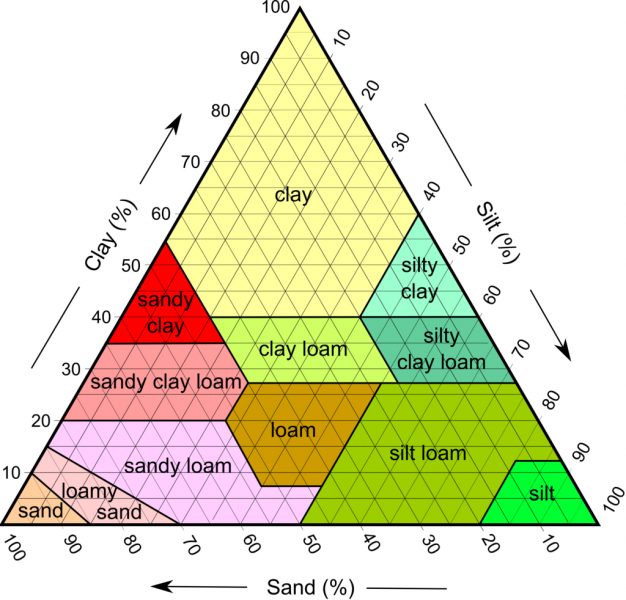
Over the years, I’ve written several articles on soil texture because it is one of the most important things a bowling greenkeeper needs to understand. The Soil Texture Triangle shows the ratio of sand, silt, and clay in the soil and thus serves as a useful indication of its suitability for supporting fine turf; it also reminds us how readily a bowling green’s root zone can end up in a dangerous area.
Many UK clubs now have to manage greens with root zones classified as sand due to years of regular sand topdressing. When a green has reached that stage, adding more sand amounts to more than just a neutral action; it takes the green further in the wrong direction, resulting in poorer nutrient and water retention and very little soil biological resilience. As a result, there is a greater need for irrigation, wetting agents and fertiliser, leading to emergency work on damaged and dying turf, increased anxiety among the committee about matches being cancelled or the club being dropped as a venue for important county events, and ultimately discussions arising over rebuilding the green at a great cost.
It is ironic that so many clubs are still employing sand top dressing in an attempt to cure problems which sand has itself caused.
The Rebuild Trap
In the last week or so, I have heard of two clubs whose greens are now scheduled for complete rebuilds because of problems associated with dry patch, weak surfaces and long-term rootzone dysfunction.
I am not going to comment on those specific greens here because every case needs proper diagnosis, but the general pattern should make every club pause. A rebuild is often treated as the final, decisive solution. Scrape off the top couple of inches, rotovate, relay, seed or turf, and start again.
That sounds clean and conclusive. But Localised Dry Patch and hydrophobic soil problems are rarely so polite.
If the underlying rootzone is still sand-dominated, inert, biologically weak and full of old water-repellent organic residues, then simply disturbing and relaying the surface may not remove the problem. In some cases it may only reset the clock. The dry patch can sit there, waiting for the next period of heat and drought to bring it back into view.
This is why a proper, relatively non-invasive renovation programme will always make more sense, agronomically and certainly financially.
And it is why a proper and urgent conversation about renovation matters before the club gets caught up in any discussion about rebuilding the green. Because the cheapest rebuild is the one you never need, a club can spend many tens of thousands of pounds rebuilding a green, lose a season or two due to re-establishment and still end up with a green that has all of the same old problems as before. Or it can start spending its normal renovation budget more intelligently now. That is the autumn opportunity, and the time to plan for it is now.
The Cost of the Sand Habit
The financial side of this is often overlooked because top dressing is seen as a normal annual cost. But let’s look at it plainly.
Five tonnes of 70/30 dressing can easily cost a club more than £1,000 before VAT, labour, machinery, aeration, scarification, brushing-in, dragmatting, seed, fertiliser and follow-up work are even considered. For many clubs, the real cost of the traditional autumn dressing operation may be closer to £1,500 to £2,000 before VAT once everything is included.
And what has the club bought? If the material is still close to 99% sand, the club may have spent a substantial chunk of its autumn budget adding more of the same material that has already pushed the green towards its present condition, essentially perpetuating the same old problems that currently beset the green.
The top dressing invoice is only the beginning. The real cost comes later, in more dry patches, more irrigation dependency, weak recovery, increased thatch problems, increased fertiliser requirement to get a response from a hungry rootzone, more disappointment when expensive new seedlings dry out and wilt, and eventually the troublesome conversation about reconstruction of the green.
If a club has £1,500 or £2,000 available for another traditional autumn dressing operation, then it has the money to start improving the condition of the green. It’s not a matter of whether or not the club can afford to do something different. The question is, can we afford not to?
This Autumn’s Chance
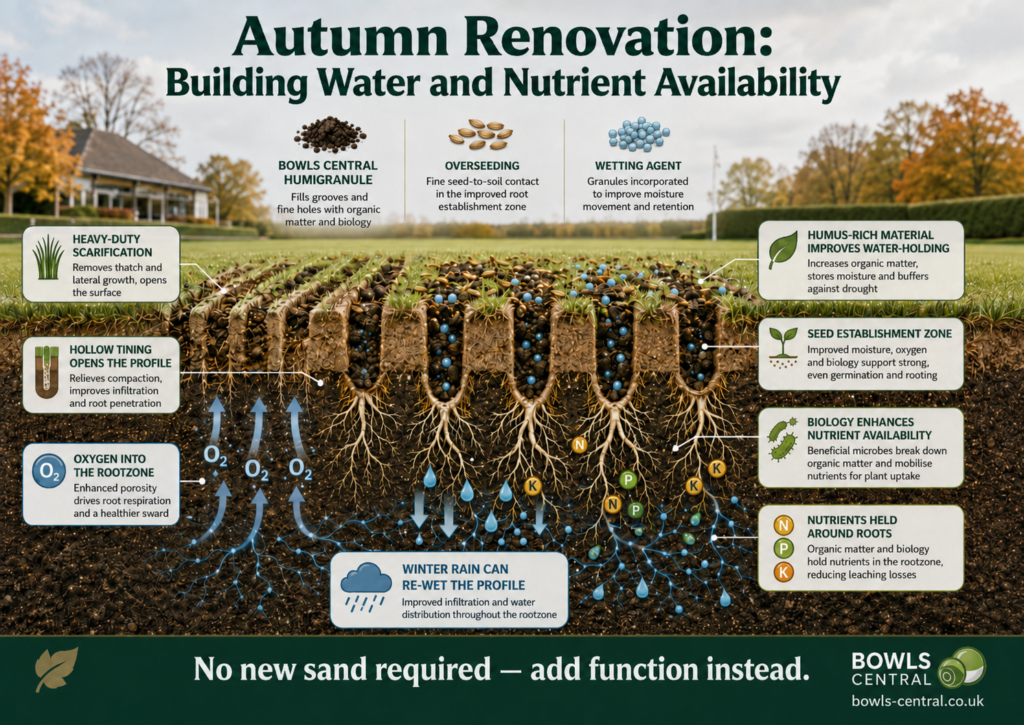
Autumn is generally the best opportunity for most clubs to break the sand cycle without causing alarm, since the mechanical work carried out as part of a proper renovation programme naturally provides the ideal access route to the root zone for new, restorative materials.
Hollow tining opens up the soil profile, removing cores and bringing a good amount of the previously purchased material to the surface, where it can be separated from the thatch, introducing oxygen and forming a network of holes in which a more useful material can be incorporated to improve the sand.
Heavy-duty scarification creates grooves in the surface, removes more accumulated thatch, and, most importantly, smashes the cores to separate the thatch from the soil within the core plugs. This brings a surprising quantity of the earlier top dressing and rootzone material up to the surface so that it can be used as part of what might be termed a not dressing programme.
Normally, at this stage, many clubs would remove all of this debris from the surface and arrange for, and spread additional sand, but it’s precisely at this point that the approach should be altered. Rather than importing another 5 tonnes of sand-based dressing, use the mechanical work to recycle and redistribute the material already on site and in the green, and to enable the addition of natural, soil-building materials that can then be brushed or matted into the grooves and holes along with the rootzone material that has been brought up by the mechanical work. The types of materials to be used will depend on the present condition of the green and its soil texture, but examples include zeolite and granular humic materials, both of which will increase the nutrient and water-holding capacity in the root zone.
The green will still be renovated and will still appear to have been top-dressed, since it actually will have been. The surface will still have material incorporated into it, but it will do a lot more good than more sand would, and none of the damage.
You won’t add any new sand; instead of adding more inert mineral material, the club will use the renovation window to put carbon, humus, biology, rooting support, and moisture and nutrient-holding functionality directly into the areas created by the work, so these soil functions will improve.
It is a completely different kind of renovation; although it appears familiar from above, underneath it is taking a far more positive course.
The Big Gulp of Oxygen
One of the most powerful aspects of this operation is at the same time one of the least noticeable… oxygen.
A root zone that is made up mainly of sand, and which has a thatchy character, and is hydrophobic, compacted, and layered can turn out to be a terrible environment for both roots and micro-organisms. The flow of water becomes uneven, and air movement is restricted. Organic material fails to break down properly, contributing to the accumulation of thatch. In one season the turf becomes wet and sour while in another it is dry and water-repellent.
Heavy scarification and hollow tining are more than simple mechanical extraction jobs; they provide an opportunity for the green to breathe. They open up the surface, remove the accumulated, undecomposed organic material which had earlier been destined to contribute to the thatch layer, and enable some of the expensive top-dressings previously applied to be pulled up to the surface, where they can then be usefully mixed with good soil-building supplements and incorporated back into the surface without having to add any more sand. They form channels, enabling gas exchange that replaces the anaerobic gases in the soil with oxygen, thereby immediately improving the soil and curing low-pH problems. They promote deeper root development and increased root mass. They make room for more and higher-quality aerobic soil life. They also increase the likelihood that rain enters the soil profile rather than pooling on the surface, running off, or leaving before it can be taken up by plants.
In cases where a localised dry patch is a problem, the hydrophobic soil will still require assistance to recover, and by adding an effective granular wetting agent to the soil when carrying out the renovation, winter rainfall is given a far better opportunity to enter and rehydrate the profile rather than just lying on the surface or taking the direct route to the drains without wetting the soil.
It represents one of the greatest opportunities that is not adequately exploited in the upkeep of bowling greens. Although winter rain is free, it only works if the soil can take it up and use it; a granular wetting agent will remain active in the soil for a while, helping with proper rewetting.
Humigranule: Putting Humus Function Back Into Sand
Sand has very little ability to hold nutrients or moisture. It doesn’t provide much cation exchange capacity, and it does very little to encourage microbial activity in the soil. A living soil needs Humus to support the proper functioning of the soil and turf ecosystem. So, in this renovation programme, we add one or two materials you might not be familiar with: BioActive Humigranule and BioActive RZ.
Humigranule is a granular humic material designed to help counteract the problems caused by excess sand in bowling green rootzones. It brings humus-like function into a profile that is often short of carbon and therefore microbial energy. It contains humic and fulvic acids and is designed to support soil structure, nutrient exchange, microbial activity, root development, stress tolerance and seed germination. It stays in the soil for the long term and becomes part of the support system for a properly functioning soil/turf ecosystem. After a while, you will start to see this appear on your soil analysis as Organic Matter (Humus), something that is critically low in many high-sand root zones. Some experts will try to conflate the term Organic Matter with thatch and convince you that it is a bad thing, but the two couldn’t be more different.
In simple terms, Humigranule helps make a sandy rootzone behave less like a bucket of inert mineral particles and a little more like a soil. That distinction matters. A typical autumn target of 10 to 15 bags of Humigranule after heavy mechanical renovation goes a long way towards rebuilding the missing carbon and humic function into the part of the profile where the grass roots need to live. By working it into the scarification grooves and tine holes, it can rebuild a living soil that supports new seedlings after oversowing and the development of root mass, all the time mixing with and ameliorating the old sand-dominated rootzone that now needs to be persuaded back towards life.
BioActive RZ: Biology Where Roots Need It
If Humigranule is about restoring humus function, BioActive RZ is about re-charging the rooting zone’s biology. This is the second part of the power combination you can apply instead of more sand.
BioActive RZ is a root zone improver built around beneficial microbes, mycorrhizal fungi, humic and fulvic acids, trace minerals together with a carefully graded carrier designed to help retain moisture and nutrients in the soil.
The fine perennial grasses do not work alone. In a healthy soil, roots operate in partnership with microbes, fungi, organic compounds, mineral exchange sites, moisture films sticking to soil particles and air spaces. In a dead, dry, sand-dominated rootzone, that partnership is weak. The plant is left trying to survive in a poor economy, with little reserve and little support.
BioActive RZ is designed to improve that rootzone economy. The mycorrhizal element is particularly important because these fungi form a symbiotic relationship with perennial turfgrass roots and help the plant explore a much greater volume of rootzone than roots can reach unaided. That matters in a sandy green where water and nutrients are often present unevenly, briefly or out of reach.
The autumn timing is ideal because the green is being opened mechanically. Holes and grooves are created, but play isn’t disrupted. Seed is being introduced. Roots are active. Moisture is returning. Soil temperatures are still usefully warm for good, solid recovery. Winter rain is on the way. There is a window to get beneficial material into the profile rather than leaving it sitting on top.
A target of 6 to 10 bags of BioActive RZ after hollow tining makes sense because the aim is to place it right in the root zone, where it can get working right away.
The Elephant in the Room…LDP
The old autumn model was often quite simple. Scarify, hollow tine, add sand, seed, fertilise, hope. In other words, put the green to bed and hope that it all works out for the best next year. However, these days, many of the greens that have driven past the Peak Sand sign are riddled with Localised Dry Patch (LDP), and trusting in good fortune isn’t an option.

If Localised Dry Patch has been a problem, this is especially important. Hydrophobic soil does not fix itself because the calendar reaches September. The water-repellent material in the profile still requires oxygen, microbial activity, moisture movement, and repeated rewetting. Incorporating a granular wetting agent during renovation gives winter rainfall a much better chance of entering and rehydrating the profile, rather than simply sitting on the surface or moving unevenly through old pathways.
This is one of the most underused opportunities in bowling green maintenance. Winter rain is free, but only if the soil can accept and use it. A granular wetting agent will remain active in the soil for months and help utilise the winter rainfall to support the recovery of LDP that you’ve been working on with Aquastasis and Yucca through the summer months.

ProWet Evolve G-granular wetting agent (15kg)
New Granular Soil Surfactant for Professional Turf Use
A new high-performance surfactant with RST technology, combined with dispersible granule technology, produces outstanding performance and reliability.
Overseeding
Autumn renovation is also the best chance many clubs have to improve grass species composition and to recover bare areas.
If the green has suffered through summer, a dry patch has thinned the sward, Poa annua has dominated weak areas, or bare patches have appeared, then the autumn renovation window should not be wasted.
However, new seed needs a fair chance. Throwing good seed into a dry, inert, hydrophobic, sand-dominated profile and relying on luck is poor economics. Seed needs soil contact, moisture, oxygen, nutrition and biological support. That is another reason why the Humigranule and RZ combination makes sense during renovation. It helps create a more favourable establishment zone at the exact moment the seed is being introduced.
The goal is not simply germination, but managed establishment. There is a difference. A seed can germinate and still fail if the aftercare and/or soil conditions aren’t right. For the first week or so after germination, grass seedlings exist solely on their seed case reserves, so it isn’t unusual to see 100% success at this stage. However, after the seed case reserve is used up, the fragile seedlings are on their own and need sustained monitoring, as even an hour or two in dry soil will cause them to wilt and die…you must ensure that there is enough soil moisture for them to have the best chance of survival.
A renovation programme should be judged not by whether green shoots appear, but by whether the new grasses survive, root, tiller, strengthen and become part of the playing surface.
If you are overseeding an already bare area…ask yourself why it is bare in the first place and address the underlying causes first.
The Green Will Still Look Top-Dressed
One concern clubs often have is visual. If we do not order the usual dressing, will the green look unfinished? This is where this autumn method is helpful. After heavy-duty scarification and hollow tining, a surprising amount of existing material can be brought to the surface. Old dressing, thatch fragments, rootzone material and debris all appear. Once the useful material is worked back in, and once Humigranule, BioActive RZ, seed, wetting agent and autumn fertiliser are incorporated, the green will still look like it has been top-dressed and the boost of oxygen will enliven it manifold compared to simply filling the holes with more sand again.
The dressing effect has been created by working with what is already in the green and adding materials that change function rather than simply adding bulk.
Of course, this matters politically inside clubs; the members see renovation. The greenkeeper sees progress. The rootzone gets something it actually needs, and the club saves the substantial cost of buying, transporting and applying another high-sand dressing. For many clubs, that saving could be in the region of £1,500 to £2,000 before VAT once material, labour and associated work are considered.
You can redirect the saved money to a proper autumn recovery programme, rather than spending it on the next layer of the problem.
The Process
Here is my recommended process for achieving the above
- On a dry day, hollow tine the green with 5/8″ tines at 2″ centres…leave the cores on the green surface for now.
- Immediately after hollow tining, use a heavy-duty scarifier in the same direction as the hollow tining. This should go into the thatch again, and will also smash up the cores you previously left on the surface. This will separate the thatch from the soil in the cores.
- If you have established that you have excessive sand in the root zone and low Humus, then 10 bags of Humigranule and 6 bags of BioActive RZ can now be applied using a fertiliser spreader. If your green has also been affected by LDP, you can apply 1 tub (15kg) of Prowet Evolve G Granular Wetting Agent at the same time.
- You can also apply seed at this point using a fertiliser spreader.
- Brush and/or drag mat the rootzone/topsoil material into the holes and grooves left by the earlier mechanical operations. You might have to leave some drying time between passes to facilitate this. Brush/Mat the green several times until most of the material has been worked into the green.
- Blow off the wispy, thatch-like material left on the surface with a leaf blower.
- Lightly water the material if conditions are very dry.
- Cut the green with the mower set at 8mm to clean up. Use your second mower if you have two to save the blades on the good mower.
- After a week or even 2 weeks, you can apply 3 bags of Prolong 12.0.15 fertiliser.
Using this method, you will remove around 20% of the surface area and, therefore, a lot of thatch. You will also introduce a significant amount of air into the soil, which will accelerate the natural breakdown of thatch afterwards. The scarifier will mostly close the hollow tine holes, and the brush will ensure the grooves are filled without adding any further top-dressing. A small proportion of the seed will inevitably remain on the surface, but the majority of it will be under the surface ready to germinate. Sometimes it takes two to three seasons of this kind of work before the green is ready for seed because of excessive thatch buildup.

Hi
If we were to follow your recommendations for Autumn Renovations (Not Dressing Program) on a 1600 M2 Green
what are the quantities required for each of the active products in Bags.
Plus postage costs .
Regards Rob. K.
Green Keeper.
Shirepark Bowls Club.
Hertfordshire
AL6 0HT
Hi Rob
There is actually a ready made pack of materials in the shop for this: Peak Sand Autumn Renovation Pack
I’ll email you a full quotation in a minute, but also have a look at the Academy Packages as these can save you bit of money on materials and also has free delivery on all orders to mainland GB addresses. Details here: https://bowls-central.co.uk/product-category/education/academy-membership/
Regards
John
Morning John,
Following your program for the past 2 years and interested in your Autumn Renovation(not dressing) program, however I do need to carry out a bit of levelling(+-10bags) on the green, question is can this all be done at the same time also what is the lead time from date of order.
milton regis bowls club, kent.
Hi Wallace
Without any knowledge of your green, I can’t really comment on the first part, but allow about a week for delivery of palletised orders
Thanks
John