Home » Archives for John » Page 70

Author: John

Master Greenkeeper John Quinn is the author of Performance Bowling Greens, and several other titles on Greenkeeping, Club and Business Management.

Investing in Irrigation-can you afford not to?

Irrigation: cost or investment?

Previously we talked about some of the reasons commonly put forward for not watering bowling greens. I also shared with you, my amusement that so many clubs fail to mention irrigation or lack of it when looking for an explanation for the poor quality or condition of their greens; even though it’s very obvious. They will use just about every other aspect of bowling green maintenance as a reason for poor performance.

Now we come to the cost of irrigation; and I am not talking about the cost of installing a system, but merely the cost of the water being applied on any given night.

This is another big reason or excuse that I hear a lot about:

“we can’t water any more because it costs a fortune”

Now of course there will be variations (slight) around the country and also from system to system, but here is my 10 second rundown on the cost of water for irrigation:

  • As we saw previously a typical system will put out 1mm of irrigation water for every 2 minutes of system run time.
  • A typical system will also put out 150 litres per minute; so to calculate the cost per mm of irrigation we do this:
  • 2 (minutes) X 150 (litres) X 4 (sprinkler heads) = 1200 litres/mm

That’s to achieve 1mm over the whole green.

As 1200 litres is 1.2 m3 you simply have to multiply the irrigation requirement in millimetres by your cost per m3 and then by 1.2

Example:

  • Water balance sheet shows we need to replace 15mm of moisture loss.
  • Multiply 15 (mm) X 1.2 (m3) X £/m3
  • 1.2 (m3) X £0.90 = £1.08/mm of irrigation over entire green.

I’ve used 90p as an average cost, but you can find your own local charge on your water bill or by phoning the water company.

The question is whether you see irrigation as a cost or an investment in the future of your green.

Deal with thatch and compaction Now

Regular readers of my articles will know my views on bowling green maintenance problems; essentially there are only 2 that you have to worry about.

Everything else that goes wrong with greens is a symptom of these big 2 issues or indeed a symptom of the commonly held views on how to tackle the big 2.

What are the big 2?:

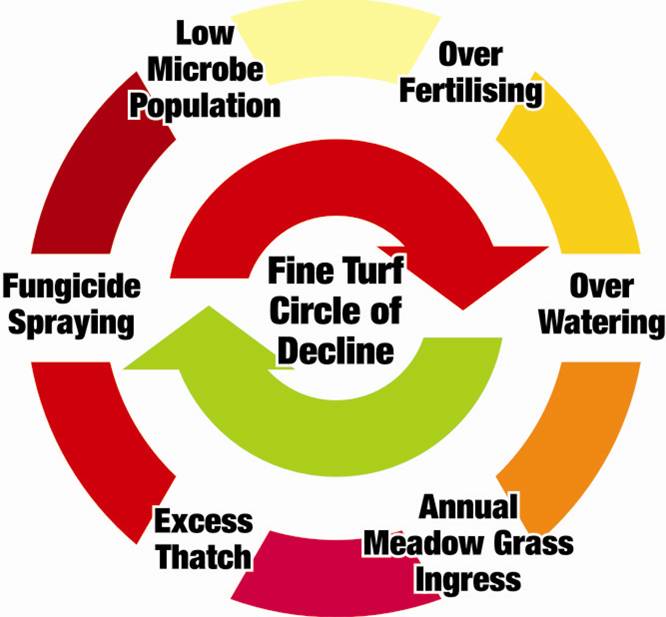
  1. Thatch: the build up of dead shoots, roots and debris on the turf surface that can get out of hand very quickly and cause or contribute to a huge number of problems. See my article on the circle of decline here
  2. Compaction: the squeezing of air out of the soil profile by foot and maintenance traffic.

Why I am banging on about this again?

Well hopefully your autumn and winter program is fully geared up to dealing with these two big issues.

By now I hope you have undertaken any major thatch removal work required and that you are now embarking on “an all winter long” attack on compaction.

Regular deep slit tining is the best way to relieve compaction; please note this is not a one off job regardless of how impressive the machine used.

It is necessary to continually slit tine the green through the winter to a depth of 150mm or deeper if you can.

Once a week isn’t too much, twice a month is more typical; stop during frost or excessively wet conditions but pick it up again as soon as possible afterwards.

For a full appraisal of essential winter maintenance tasks for your bowling green the Autumn/Winter report is still available at half price:

Autumn and Winter Bowling Green Maintenance Guide
The ultimate guide to Autumn Renovation and Winter Bowling Green Maintenance detailing the essential maintenance your bowling green needs through this most critical of maintenance seasons. What you do now will determine how the green performs next season. INSTANT DOWNLOAD ebook more details
Price: £9.97

Why has our bowls green become slippery?

This week I thought I would take some time out to address some of the questions that have led site visitors here from the search engines. We did this for a week last autumn and it was very successful with a lot of good feedback from readers.

The first one stood out to me as it seems to be a very common issue around the country and is really very simple to fix. We have a had a variety of different questions centred on greens becoming slippery.

This can happen for a variety of Read more

Bowls Green Maintenance and elephants

In the early part of the season no growth means no recovery from last winter’s damage, bare areas not filling in with new grass, bumps, hollows and all sorts of other problems mostly related to surface smoothness and consistency.

I’ve heard more than my fair share of strange reasons in bowling green maintenance circles when there is a lack of growth. These mostly centre on almost every bowling green maintenance practice except the one that matters…why?

Well the one that matters is “Irrigation” and it’s still a big taboo in a lot of clubs and in bowling green maintenance circles; it’s “the elephant in the room” to use one of the most annoying buzz phrases in recent times! However the elephant in the room description is a good one in this case; it’s this big, obvious thing in the room or in the conversation, but nobody mentions it!

One club I met with told me they have an “anti-watering brigade” in their club! Can you believe that, a group of members who are actively against watering the green regardless of how much it needs it?

On a well known bowling forum which shall remain nameless here, a contributor added his tuppence to the discussion on irrigation by “boasting” that they never water their green, as if it was some impressive badge to be worn. Another says that watering 3 times a day is crazy (as suggested by another contributor), even though he has no information to tell him the quantity of water being applied or thinking behind the plan.

We really must get over this folks or there will be a lot of very poor bowling green surfaces next year.

Bowls Green Maintenance Basics-Green Speed

There are some less than obvious essentials required to achieve consistently agreeable Green Speed

The great debate about green speed has raged on since the beginning of the game. But what are the factors known to affect green speed?

In order of their impact on green speed these are the top 7 factors that you should bear in mind. Obviously there are others such as weather patterns, level of play etc, but these are largely out of the greenkeepers control and in any case do not figure highly in green speed management.

Thatch Layer Control and Management; this means knowing the thatch levels on your green and having a feel for how quickly thatch builds up at each point in the year.

Typically thatch will be much quicker to build up in the main growing season and it can easily take greenkeepers by surprise if they don’t keep a watchful eye on the situation.

Reducing a troublesome thatch layer significantly is a job best left for the autumn when severe measures can more safely be taken, but following the Performance Greens program will ensure that you are minimising the occurrence of new thatch through the production and maintenance of a healthy living rootzone and turf.

You can find more in-depth articles on thatch here.
Compaction Control and Relief; Second only to thatch in causing green problems, Compaction is a Read more