Home » performance greens » Page 7

Tag: performance greens

The Pursuit of Excellence and…economy.

Now that the new season is upon us, we’ve been getting a lot of enquiries asking two basic questions:

What is the ideal maintenance program to ensure an excellent bowling green surface this year? and…

How can we reduce costs for maintenance without compromising the performance of the green?

Well, although both of these questions are fairly easy to answer, the actual solution depends a lot on what has gone before and at what stage your green is at, in terms of performance at the moment.

The pursuit of excellence on a sensible budget is very much the theme of Performance Bowling Greens.

In the book you will find a step by step blueprint in layman’s terms where John explains the reasons why most bowling greens don’t perform to the required standard, or if they do, why they don’t seem capable of perfoming consistently over the long term.

Also in the book John talks about his philosophy on high performance bowling greens, what makes them and how to achieve a tournament quality green on a reasonable budget, consistently.

John said ” I decided to write this book to detail in layman’s terms the exact formula needed for a great bowling green. A formula that is based on thorough scientific research and experience”

He went on to say: “I also wanted to alert bowling club officials and greenkeepers to the 4 major obstacles that stand in their way, the 4 obstacles that repeatedly stop them from producing the green they desire, so that hopefully they can learn to spot these and avoid them in the future.”

You can get hold of your copy of Performance Bowling Greens here.
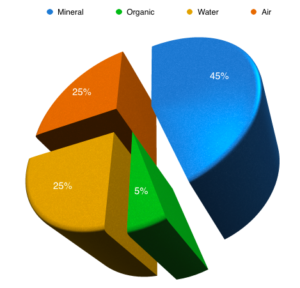
Sub-Surface Requirements for a High Performance Bowls Green

Perfect Soil

The Sub-Surface Requirements for a High Performance Bowls Green are pretty much set in stone. Get these right and you’re well on your way to a Performance Bowling Green.

First of all then, have a look at the diagram above. This represents the ideal make up of a performance bowls green’s rootzone.

Do you see anything remarkable?

Well, when I explain this to my clients for the first time, many of them are surprised to say the least.

If you look closely at the diagram you will see that the ideal green will be 50% nothing; yes space, just air cavities within the soil. Now, of course I am not going to tell you to get rid of half your green to achieve this, but next week I am going to share with you a program whereby you can get close to this ideal situation of ½ solids and ½ space in your green.

Of course the space isn’t just nothing; half of the space consists of “micro-pores” and half is “macro-pores”. Put simply the micro-pores contain water and the macro-pores contain air. This is very important to understand and is one of the least understood concepts within sportsturf maintenance.

The “nothing” element of the ideal green is the most important factor to get right, because this is where we get the balance between speedy drainage and good growing conditions and it is due to a fundamental misunderstanding of this concept that a very large number of UK bowling greens are in poor condition and can’t be prepared for performance consistently. The only saving grace for these greens is that the UK summer is also very inconsistent and sometimes acts in their favour; so that we occasionally get a very good season’s bowling when the “green has never been better”. This is a false reading in most cases and the problem is exacerbated by the club attributing this success to the latest fad program.

The green which has a well balanced soil as described and illustrated above will naturally:

  1. sustain a firm, fast surface with a minimal input maintenance program
  2. sustain a healthy sward of fine grasses
  3. sustain a high, year-round population of soil microbes
  4. provide a natural cycle of nutrient release from soil organisms and micro-organisms (microbes) working on fresh organic matter (thatch).
  5. resist compaction and therefore resist:
  6. shallow rooting
  7. annual meadow grass ingress
  8. flooding and puddling
  9. head skinning
  10. retain the optimum amount of soil water for healthy growth with minimum requirement for artificial irrigation.
  11. drain reasonably quickly after excessive rainfall.
  12. retain the optimum amount of plant available nutrition
  13. sustain a soil pH within the optimum range for fine turf
  14. resist attack from fungal diseases
  15. resist the onset of Localised Dry Patch and other soil and turf disorders
  16. maintain a tight, dense sward with an upright growth habit which will reduce ingress of moss, weeds and weed grasses.
  17. resist localised settlement and bumpiness due to excessive thatch and erratic thatch decomposition

Comprehensive action plan for achieving the above included in the book below. It costs less than a bag of cheap fertiliser.

Deeper Faster Bigger…Better…Not in Bowls Green Maintenance!

Next question to ask as a matter of urgency:

Does anyone have plans to get rid of compaction once and for all by hiring in a guy with a tractor and a big spiker that can go in 12, 16, 18, 20 inches? You add your own number here.

Pointers:

  1. Compaction is an on-going issue; it’s natural and happens due to play, maintenance, weather etc.
  2. There are of course factors that make compaction worse or better such as soil type and maintenance.
  3. You can’t “get rid” of compaction once and for all; compaction management is an on-going bowling green maintenance task.
  4. Compaction relief is best tackled mainly throughout the winter months by old fashioned (unfashionable) deep slit tining to 6-8 inches depth.
  5. Green flooding is more commonly caused by thatch than compaction
  6. Deeper isn’t better in this case; anything deeper than 8 inches risks damaging the subgrade of your green permanently.
  7. Don’t take a tractor on your green please!

Transforming your Bowls Green-the knowledge.

I keep going on about healthy living soil and healthy living turf and healthy living bowling greens on this site.

In my eBook Performance Bowling Greens, a practical guide, I focus heavily on the process of turning bowling greens back in to healthy living eco systems that are pretty much self sustaining.

By self sustaining I mean that they are in a condition that allows them to be set up and prepared for play in a consistently high performance manner with no pesticides and minimal on-going in-put costs.

This relies on the green being converted from a barren, sand laden, resource swallowing beast that is unpredictable at best and disappointing and expensive at worst.

This conversion process demands two qualities in those who seek to deliver a Performance Bowling Green:

Knowledge, that you are doing the right thing and the Patience to spend the time following the program.

Performance Bowling Greens spells out this process in great detail, but here in basic terms are the key points of knowledge that are important to a successful transition:

  1. Soil micro-life is critically important; this refers to the microscopic life in all soils and includes beneficial fungi which help plants to assimilate nutrients (which fungicides get rid of), and soil microbes, which help to turn organic matter (mainly thatch) into plant useable nutrient ions.
  2. Every time you add sand to the green, the abundance of soil micro-life reduces; sand is inert.
  3. Sandy soils generally have a lower Cation Exchange Capacity (the ability to retain the plant useable nutrient ions created by the soil microbes).
  4. There are two distinctly different kinds of pore space in soils; micro or capillary pore space where plant roots take up moisture and nutrients; and macro or aeration pore space where drainage occurs (to stop the soil from being saturated with water), and oxygen (critical to maintaining a large population of soil microbes) is held.
  5. Compaction ruins the structure of the soil and reduces aeration pore space, oxygen content and soil microbe populations. This is why compacted greens seem to need more and more fertiliser. Compaction + More Fertiliser = Thatch and so the downward spiral into the Circle of Decline begins.

These are 5 guiding principles if you like for a consistently high performance green. You will notice that this is not a list of things to do, but a list of key things to keep in mind, to focus on as we patiently go about the transition process. You can be confident that if you are heading in this direction you are heading in the right direction regardless of how long the road is.

And you can be confident that the view will improve (in the shape of performance) around every corner of that road.

Calcium in performance bowls green management

A regular reader asked this week about Calcium and its role in turf management.

To answer here is an excerpt from my eBook, Performance Bowling Greens

Calcium is needed by plants to grow and maintain health. It is a key constituent of cell walls.

Once fixed in the plant, calcium ceases to be mobile and this means if the calcium supply runs out the plant can’t move it around to where it is needed, it must take more in. This means in times of low transpiration, the grass plant can quickly run out of calcium.

If calcium availability is low or compromised grass plants can experience a range of difficulties

  • Every plant needs calcium to grow.
  • Once fixed, calcium is not mobile in the plant. It is an important constituent of cell walls and can only be supplied in the xylem sap. Thus, if the plant runs out of a supply of calcium, it cannot remobilise calcium from older tissues.
  • If transpiration is reduced for any reason, the calcium supply to growing tissues will rapidly become inadequate.

Calcium plays a very important role in Read more