Home » irrigation » Page 3

Tag: irrigation

Annual Meadowgrass

Poa annua ad infinitum

Yes I’ve come over all Latin today; and no, it’s not because I can’t believe my old jeep sailed through its MOT yet again last week!

Even the garage owner was amazed that he couldn’t find anything wrong with it.

He sent me off with “I’ll get you next year!”

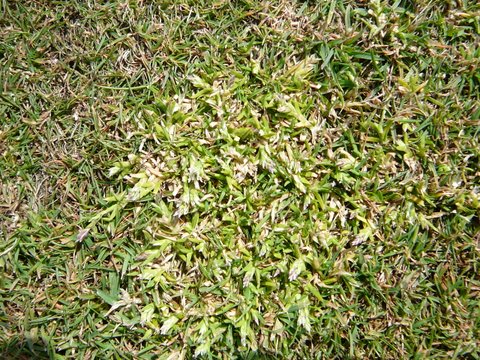
No, the Latin was inspired by a photo I received from a regular reader who sent it in to illustrate a problem he had on his green with red-thread.

However, the reason for this post is not to discuss Latin, or Red-Thread for that matter.

The clump of grass in the centre of the photo is annual meadow grass, or Poa annua to use its botanic name.

It’s not that we greenkeepers are more cultured than the average man in the street, more to do with college lecturers who insisted that we learned to identify and remember the botanic names for hundreds of grasses, trees, shrubs and weeds.

Incidentally this came in useful when I was leaving the MOT station, as I casually threw in a final, killer comment of “you need to get your Tarixicum officianale (dandelion) sprayed before it takes over the yard!”

Back to the clump of meadow grass.

This is actually a weed ( an unwanted plant in its current state and location) as we are really trying to create and maintain a sward of finer fescue and bent grasses for the best bowling surfaces.

Unfortunately, almost (probably all) all of the bowling greens in the UK will be infested with this grass.

Even newly built greens constructed on sterile rootzone material will show signs of this weed within 2 years as its seed blows in from the surrounding area.

From the picture you can see it at its worst aesthetically, which it usually is at this time of year. Right through May and June it will show up as unsightly clumps of lime green grass which contrasts vividly with the other darker green species.

Also at this time it will be seeding like mad.

The visual problem recedes as the summer progresses, but it does actually produce seed all year round.

Scarifying, verti-cutting and close mowing are of minimal value in removing the seed heads and to some extent can actually help annual meadow grass to thrive in the summer.

This is because it has a very low and prostrate growth habit which keeps the majority of the plant including seed heads below the cutting blades.

Excessive scarification and verti-cutting can actually weaken the finer fescue grass leaving the annual meadow grass with a stronger chance of survival.

It does have one Achilles heel and that is water.

Poa annua is a very shallow rooting grass and the Performance Greens program is designed to allow greenkeepers to keep the surface of their greens a little drier than most, thus putting the weed grass under pressure.

This is achieved by managing irrigation to ensure that the green is watered deeply, but irregularly which also has the effect of encouraging deeper rooting of the finer, desirable grasses.

The program also calls for a more sensible approach to cutting heights, whilst using other methods to achieve green speed. This allows the finer grasses to put down even deeper roots and also strengthens plants against drought and wear.

Poa annua is however likely to be with us ad infinitum as it is a very adaptable grass.

This adaptability is actually a good thing in the end as over time the grass becomes finer and blends in more readily with the finer grasses.

It is perfectly feasible still, however, to have a green that is predominantly fine and to keep Poa annua under control over the long term by following a sensible program that encourages the development of a healthy living soil which in turn will support a strong and dense sward of finer grass.


Performance bowls green properties.

How can we ensure a consistently high performance bowling green that is economical to produce and maintain. There are 4 specific goals that we need to achieve to say that we have such a green:

Green Speed; the actual surface pace that we can reasonably expect from the green on a regular basis.
Consistency; the ability of the green to replicate high performance throughout the day, week and season and also from season to season.
Predictability; the ability of the green and individual rinks to be set up for play of a reasonably predictable nature, time after time and over time.
Achievability; high performance must be not only physically achievable but also relatively easily achievable and for that the program we put in place must tick the following boxes; it must be:

Workable; with “in-house” labour and skills or with a financially sustainable amount of “bought in” labour and skills.
Sustainable in terms of its environmental, financial and infrastructural requirements.
Replicable time after time within the parameters defined above.
Minimum Input in terms of artificial fertilisers, chemicals and expensive bought in machinery or skills.

The goals we have set above require us to produce a very specific kind of green surface.

Act now on green dry patch

LDP, localised dry patch on bolwing green
spring is a critical time for LDP management

If your green has suffered the blight of localised dry patch (LDP), sometimes called bowling green dry patch in the past, this is the most critical time of the year to take action to minimise the chances of another outbreak.

It’s unlikely that you will be thinking about irrigation of the green just yet, but dry weather in March and April, usually accompanied by drying winds which cause further moisture loss from the green surface can allow LDP to take a firm grip on the green.

The main effects of this might not show up until June, but the damage will already be done and no amount of irrigation will correct this once it has taken hold.

With this in mind and especially if your green has suffered in the past, you should at minimum be keeping an eye on your water balance chart and making irrigation applications to replenish any deficiencies, even if it seems counter intuitive…trust your water balance sheet!

Now is also a good time to mini-tine the green and apply a granular wetting agent, making sure it is washed into the tine holes thoroughly.

Monthly liquid wetting agent applications should also commence now and the water balance sheet (not Charlie, the club champion in 1977, who doesn’t believe in watering greens!) should rule the roost as far as irrigation decisions are concerned.

Much more on LDP here.

Investing in Irrigation-can you afford not to?

Irrigation: cost or investment?

Previously we talked about some of the reasons commonly put forward for not watering bowling greens. I also shared with you, my amusement that so many clubs fail to mention irrigation or lack of it when looking for an explanation for the poor quality or condition of their greens; even though it’s very obvious. They will use just about every other aspect of bowling green maintenance as a reason for poor performance.

Now we come to the cost of irrigation; and I am not talking about the cost of installing a system, but merely the cost of the water being applied on any given night.

This is another big reason or excuse that I hear a lot about:

“we can’t water any more because it costs a fortune”

Now of course there will be variations (slight) around the country and also from system to system, but here is my 10 second rundown on the cost of water for irrigation:

  • As we saw previously a typical system will put out 1mm of irrigation water for every 2 minutes of system run time.
  • A typical system will also put out 150 litres per minute; so to calculate the cost per mm of irrigation we do this:
  • 2 (minutes) X 150 (litres) X 4 (sprinkler heads) = 1200 litres/mm

That’s to achieve 1mm over the whole green.

As 1200 litres is 1.2 m3 you simply have to multiply the irrigation requirement in millimetres by your cost per m3 and then by 1.2

Example:

  • Water balance sheet shows we need to replace 15mm of moisture loss.
  • Multiply 15 (mm) X 1.2 (m3) X £/m3
  • 1.2 (m3) X £0.90 = £1.08/mm of irrigation over entire green.

I’ve used 90p as an average cost, but you can find your own local charge on your water bill or by phoning the water company.

The question is whether you see irrigation as a cost or an investment in the future of your green.

Bowls Green Maintenance and elephants

In the early part of the season no growth means no recovery from last winter’s damage, bare areas not filling in with new grass, bumps, hollows and all sorts of other problems mostly related to surface smoothness and consistency.

I’ve heard more than my fair share of strange reasons in bowling green maintenance circles when there is a lack of growth. These mostly centre on almost every bowling green maintenance practice except the one that matters…why?

Well the one that matters is “Irrigation” and it’s still a big taboo in a lot of clubs and in bowling green maintenance circles; it’s “the elephant in the room” to use one of the most annoying buzz phrases in recent times! However the elephant in the room description is a good one in this case; it’s this big, obvious thing in the room or in the conversation, but nobody mentions it!

One club I met with told me they have an “anti-watering brigade” in their club! Can you believe that, a group of members who are actively against watering the green regardless of how much it needs it?

On a well known bowling forum which shall remain nameless here, a contributor added his tuppence to the discussion on irrigation by “boasting” that they never water their green, as if it was some impressive badge to be worn. Another says that watering 3 times a day is crazy (as suggested by another contributor), even though he has no information to tell him the quantity of water being applied or thinking behind the plan.

We really must get over this folks or there will be a lot of very poor bowling green surfaces next year.