
Home » localised dry patch » Page 5

Tag: localised dry patch

Investing in Irrigation-can you afford not to?

Irrigation: cost or investment?

Previously we talked about some of the reasons commonly put forward for not watering bowling greens. I also shared with you, my amusement that so many clubs fail to mention irrigation or lack of it when looking for an explanation for the poor quality or condition of their greens; even though it’s very obvious. They will use just about every other aspect of bowling green maintenance as a reason for poor performance.

Now we come to the cost of irrigation; and I am not talking about the cost of installing a system, but merely the cost of the water being applied on any given night.

This is another big reason or excuse that I hear a lot about:

“we can’t water any more because it costs a fortune”

Now of course there will be variations (slight) around the country and also from system to system, but here is my 10 second rundown on the cost of water for irrigation:

  • As we saw previously a typical system will put out 1mm of irrigation water for every 2 minutes of system run time.
  • A typical system will also put out 150 litres per minute; so to calculate the cost per mm of irrigation we do this:
  • 2 (minutes) X 150 (litres) X 4 (sprinkler heads) = 1200 litres/mm

That’s to achieve 1mm over the whole green.

As 1200 litres is 1.2 m3 you simply have to multiply the irrigation requirement in millimetres by your cost per m3 and then by 1.2

Example:

  • Water balance sheet shows we need to replace 15mm of moisture loss.
  • Multiply 15 (mm) X 1.2 (m3) X £/m3
  • 1.2 (m3) X £0.90 = £1.08/mm of irrigation over entire green.

I’ve used 90p as an average cost, but you can find your own local charge on your water bill or by phoning the water company.

The question is whether you see irrigation as a cost or an investment in the future of your green.
Bowls Green Maintenance and elephants

In the early part of the season no growth means no recovery from last winter’s damage, bare areas not filling in with new grass, bumps, hollows and all sorts of other problems mostly related to surface smoothness and consistency.

I’ve heard more than my fair share of strange reasons in bowling green maintenance circles when there is a lack of growth. These mostly centre on almost every bowling green maintenance practice except the one that matters…why?

Well the one that matters is “Irrigation” and it’s still a big taboo in a lot of clubs and in bowling green maintenance circles; it’s “the elephant in the room” to use one of the most annoying buzz phrases in recent times! However the elephant in the room description is a good one in this case; it’s this big, obvious thing in the room or in the conversation, but nobody mentions it!

One club I met with told me they have an “anti-watering brigade” in their club! Can you believe that, a group of members who are actively against watering the green regardless of how much it needs it?

On a well known bowling forum which shall remain nameless here, a contributor added his tuppence to the discussion on irrigation by “boasting” that they never water their green, as if it was some impressive badge to be worn. Another says that watering 3 times a day is crazy (as suggested by another contributor), even though he has no information to tell him the quantity of water being applied or thinking behind the plan.

We really must get over this folks or there will be a lot of very poor bowling green surfaces next year.

Localised Dry Patch still causing problems in autumn

Localised Dry Patch causing seed problems

Over-seeding of bowling greens seems like a straight-forward task; you put the seed on and the green’s bare areas recover.

However, one of our regular readers has raised an interesting question today about over-seeding and it is by no means isolated.

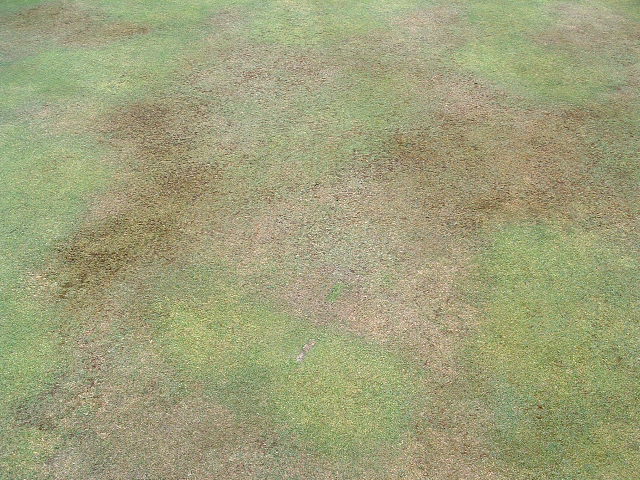
After over-seeding the green, the seed has taken well on the parts of the green that least needed it and nothing has happened on the barest areas of the green where the new grass is most needed!

This is unfortunately a very common problem and is usually related to our old friend Localised Dry Patch (LDP).

The barest areas of the green going into the autumn are usually the spots that have been affected by LDP and as such are bare due to lack of soil moisture.

This means that quite a lot of preparation is required before seeding and this might even include heavy watering to get the soil to hold enough moisture to get the seed off to a good start.

It might be necessary to do some light cultivation with a Sarrell roller or hand cultivator and, if the underlying soil is still dry and water repellent, a wetting agent would also help.

The main problem is that we are now a bit late for further seeding, although this largely depends on the weather and temperature. I have seeded successfully up to Christmas in the past, but success with this is obviously dependent on the remainder of the winter. Certainly if we were to get another one like last year, even early seedings will struggle to survive the winter.

If anybody is still having trouble getting grass cover on the green after overseeding please feel free to contribute ideas, tips or questions to the site.