
Home » Archives for John » Page 71

Author: John

Master Greenkeeper John Quinn is the author of Performance Bowling Greens, and several other titles on Greenkeeping, Club and Business Management.

Bowls Green Maintenance and elephants

In the early part of the season no growth means no recovery from last winter’s damage, bare areas not filling in with new grass, bumps, hollows and all sorts of other problems mostly related to surface smoothness and consistency.

I’ve heard more than my fair share of strange reasons in bowling green maintenance circles when there is a lack of growth. These mostly centre on almost every bowling green maintenance practice except the one that matters…why?

Well the one that matters is “Irrigation” and it’s still a big taboo in a lot of clubs and in bowling green maintenance circles; it’s “the elephant in the room” to use one of the most annoying buzz phrases in recent times! However the elephant in the room description is a good one in this case; it’s this big, obvious thing in the room or in the conversation, but nobody mentions it!

One club I met with told me they have an “anti-watering brigade” in their club! Can you believe that, a group of members who are actively against watering the green regardless of how much it needs it?

On a well known bowling forum which shall remain nameless here, a contributor added his tuppence to the discussion on irrigation by “boasting” that they never water their green, as if it was some impressive badge to be worn. Another says that watering 3 times a day is crazy (as suggested by another contributor), even though he has no information to tell him the quantity of water being applied or thinking behind the plan.

We really must get over this folks or there will be a lot of very poor bowling green surfaces next year.

for effective Bowls Green Maintenance water Deeply not Daily!

Bowling green irrigation or watering is often mis-understood and as a result is often managed insufficiently to ensure that the green performs to its highest standards.

The first thing is to make sure of, is that you are applying enough water every week and that means trying as best you can to keep a record of any rainfall and irrigation that is going onto the green.

Making irrigation management a priority in your bowling green maintenance program is crucial because in a typical dry week your green will lose the equivalent of 25mm of moisture through evaporation from the soil and transpiration from the grass plants ; please remember that this varies considerably around the country and will depend on things like temperature, relative humidity, wind speed and direction, precipitation and of course your bowling green maintenance program.

This means that you should be aiming to get at least that amount back on.

In Performance Bowling Greens, a practical guide I go into detail about Soil Moisture Deficit and how to keep a water balance sheet for the most accurate and efficient way to manage irrigation and that is a really good method to use to get this right.

However, bowling green maintenance at the height of the summer relies a lot on feel for the soil as well and although I would always try to maintain a manageable Soil Moisture Deficit to encourage deeper rooting etc, it is more important right now to get on sufficient water to ensure your green plays consistently and to keep localised dry patch under control or hopefully at bay.

This means you should be aiming to get 25mm of water on in any dry week, making allowances for any rainfall you have had by reducing that amount accordingly.

The most common pump and sprinkler set ups for bowling green maintenance from most of the major irrigation manufacturers will put out approximately 1mm of water for each 2 minutes of system run time.

This means that you need to run the system for 2 minutes per head to replace 1mm of water lost. Remember that is “per head”.

So for a 25mm watering you need to run the system for 50 minutes per head during a 7 day period.

The most effective way to do this is to get this water on in as few applications as possible. Try to aim for 25mm over 3 nights. This is much more effective and makes much better use of precious water than 7 light applications where much of the water is lost to evaporation in the morning.

In my Bowling Green Maintenance book: Performance Greens, a practical guide I go into this subject in quite a bit of detail and lay out a plan that you can use to manage irrigation more effectively.

Sub-Surface Requirements for a High Performance Bowls Green

Perfect Soil

The Sub-Surface Requirements for a High Performance Bowls Green are pretty much set in stone. Get these right and you’re well on your way to a Performance Bowling Green.

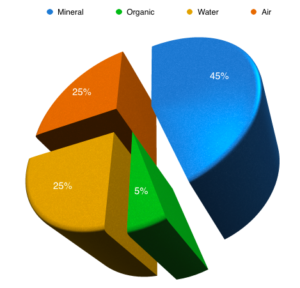
First of all then, have a look at the diagram above. This represents the ideal make up of a performance bowls green’s rootzone.

Do you see anything remarkable?

Well, when I explain this to my clients for the first time, many of them are surprised to say the least.

If you look closely at the diagram you will see that the ideal green will be 50% nothing; yes space, just air cavities within the soil. Now, of course I am not going to tell you to get rid of half your green to achieve this, but next week I am going to share with you a program whereby you can get close to this ideal situation of ½ solids and ½ space in your green.

Of course the space isn’t just nothing; half of the space consists of “micro-pores” and half is “macro-pores”. Put simply the micro-pores contain water and the macro-pores contain air. This is very important to understand and is one of the least understood concepts within sportsturf maintenance.

The “nothing” element of the ideal green is the most important factor to get right, because this is where we get the balance between speedy drainage and good growing conditions and it is due to a fundamental misunderstanding of this concept that a very large number of UK bowling greens are in poor condition and can’t be prepared for performance consistently. The only saving grace for these greens is that the UK summer is also very inconsistent and sometimes acts in their favour; so that we occasionally get a very good season’s bowling when the “green has never been better”. This is a false reading in most cases and the problem is exacerbated by the club attributing this success to the latest fad program.

The green which has a well balanced soil as described and illustrated above will naturally:

  1. sustain a firm, fast surface with a minimal input maintenance program
  2. sustain a healthy sward of fine grasses
  3. sustain a high, year-round population of soil microbes
  4. provide a natural cycle of nutrient release from soil organisms and micro-organisms (microbes) working on fresh organic matter (thatch).
  5. resist compaction and therefore resist:
  6. shallow rooting
  7. annual meadow grass ingress
  8. flooding and puddling
  9. head skinning
  10. retain the optimum amount of soil water for healthy growth with minimum requirement for artificial irrigation.
  11. drain reasonably quickly after excessive rainfall.
  12. retain the optimum amount of plant available nutrition
  13. sustain a soil pH within the optimum range for fine turf
  14. resist attack from fungal diseases
  15. resist the onset of Localised Dry Patch and other soil and turf disorders
  16. maintain a tight, dense sward with an upright growth habit which will reduce ingress of moss, weeds and weed grasses.
  17. resist localised settlement and bumpiness due to excessive thatch and erratic thatch decomposition

Comprehensive action plan for achieving the above included in the book below. It costs less than a bag of cheap fertiliser.

Getting Bowls Green Irrigation Right

Bowls clubs are often divided on whether to water the green or not. When I visit clubs to advise on this, they are generally under-watering their greens.

This results in poor surfaces, especially when a green is still within the renovation phase as described in my book Performance Bowling Greens.

You can think of Soil Moisture Deficit in much the same way as a negative balance in your bank account.

Soil Water Balance Management

…is almost unheard of within bowling circles or certainly the bowling circles I have been involved with but is a critical part of the management program to get right for high performance and deals with the management or Read more

Irrigation, how much is enough?

Irrigation, how much is enough?
irrigation management is critical but straight forward

Irrigation is on everyone’s mind at the moment, but how much is enough?

As a general rule greens lose approximately 3-4mm of moisture per dry day to evapo-transpiration, although this can vary with conditions; that’s approximately 25mm or 1 inch per week.

Again a very general rule is that many of the more popular automatic sprinkler systems will apply around 1mm of water for every 2 minutes of run time.

So again as a general rule to replace a week’s worth of losses you should be running the sprinklers for around 50 minutes in the week.

Now I will add a qualification or four to that:

  1. requirements can vary widely depending on location and conditions.
  2. don’t apply light applications on a nightly basis, try to group these into heavier and less frequent applications for best effect.
  3. try to move to a water balance sheet type system to manage irrigation more accurately…it will pay off quickly
  4. don’t rely on a typical bowling green irrigation system to apply water evenly or in sufficient volume…always check and measure what you are doing.

Irrigation management and water balance sheets in my book Performance Bowling Greens.

any questions please ask!