Home » LDP » Page 4

Tag: LDP

Performance bowls green properties.

How can we ensure a consistently high performance bowling green that is economical to produce and maintain. There are 4 specific goals that we need to achieve to say that we have such a green:

Green Speed; the actual surface pace that we can reasonably expect from the green on a regular basis.
Consistency; the ability of the green to replicate high performance throughout the day, week and season and also from season to season.
Predictability; the ability of the green and individual rinks to be set up for play of a reasonably predictable nature, time after time and over time.
Achievability; high performance must be not only physically achievable but also relatively easily achievable and for that the program we put in place must tick the following boxes; it must be:

Workable; with “in-house” labour and skills or with a financially sustainable amount of “bought in” labour and skills.
Sustainable in terms of its environmental, financial and infrastructural requirements.
Replicable time after time within the parameters defined above.
Minimum Input in terms of artificial fertilisers, chemicals and expensive bought in machinery or skills.

The goals we have set above require us to produce a very specific kind of green surface.

Act now on green dry patch

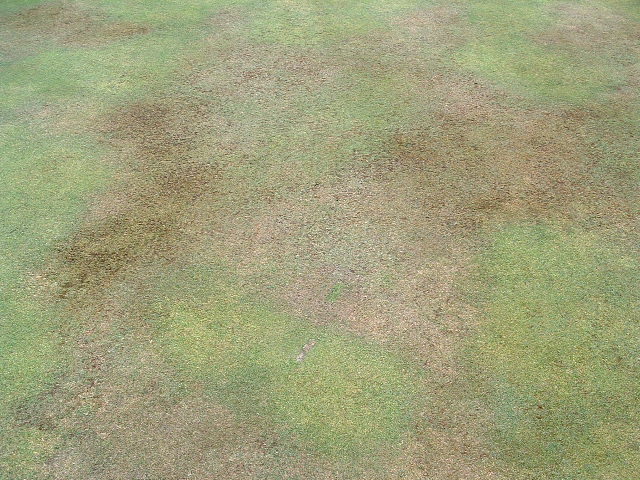
LDP, localised dry patch on bolwing green
spring is a critical time for LDP management

If your green has suffered the blight of localised dry patch (LDP), sometimes called bowling green dry patch in the past, this is the most critical time of the year to take action to minimise the chances of another outbreak.

It’s unlikely that you will be thinking about irrigation of the green just yet, but dry weather in March and April, usually accompanied by drying winds which cause further moisture loss from the green surface can allow LDP to take a firm grip on the green.

The main effects of this might not show up until June, but the damage will already be done and no amount of irrigation will correct this once it has taken hold.

With this in mind and especially if your green has suffered in the past, you should at minimum be keeping an eye on your water balance chart and making irrigation applications to replenish any deficiencies, even if it seems counter intuitive…trust your water balance sheet!

Now is also a good time to mini-tine the green and apply a granular wetting agent, making sure it is washed into the tine holes thoroughly.

Monthly liquid wetting agent applications should also commence now and the water balance sheet (not Charlie, the club champion in 1977, who doesn’t believe in watering greens!) should rule the roost as far as irrigation decisions are concerned.

Much more on LDP here.

Getting Bowls Green Irrigation Right

Bowls clubs are often divided on whether to water the green or not. When I visit clubs to advise on this, they are generally under-watering their greens.

This results in poor surfaces, especially when a green is still within the renovation phase as described in my book Performance Bowling Greens.

You can think of Soil Moisture Deficit in much the same way as a negative balance in your bank account.

Soil Water Balance Management

…is almost unheard of within bowling circles or certainly the bowling circles I have been involved with but is a critical part of the management program to get right for high performance and deals with the management or Read more

Irrigation, how much is enough?

Irrigation, how much is enough?
irrigation management is critical but straight forward

Irrigation is on everyone’s mind at the moment, but how much is enough?

As a general rule greens lose approximately 3-4mm of moisture per dry day to evapo-transpiration, although this can vary with conditions; that’s approximately 25mm or 1 inch per week.

Again a very general rule is that many of the more popular automatic sprinkler systems will apply around 1mm of water for every 2 minutes of run time.

So again as a general rule to replace a week’s worth of losses you should be running the sprinklers for around 50 minutes in the week.

Now I will add a qualification or four to that:

  1. requirements can vary widely depending on location and conditions.
  2. don’t apply light applications on a nightly basis, try to group these into heavier and less frequent applications for best effect.
  3. try to move to a water balance sheet type system to manage irrigation more accurately…it will pay off quickly
  4. don’t rely on a typical bowling green irrigation system to apply water evenly or in sufficient volume…always check and measure what you are doing.

Irrigation management and water balance sheets in my book Performance Bowling Greens.

any questions please ask!

What does top dressing a bowls green do?

In spite of the common misconception that it does a lot of good and that it is an essential part of annual bowling green maintenance, in broad terms it does very little of good towards levelling the surface, drains club’s of much needed cash and actually causes untold damage to the green eco-system over time.

There are many more articles detailing the reasons for this conclusion here.