Home » Greenkeeping » Page 41

Category: Greenkeeping

a lot of hot air?

Air is a very important component of a Performance Bowling Green.

50% of a healthy, performance green will be air; 25% Micro-pores and 25% Macro-pores.

The Macro Pore or “aeration” space is where drainage happens.

The Micro-Pore or “capillary” space is where grass plant roots get their water and nutrients.

Tip the balance in favour of one or the other of these and things start to go wrong.

Compaction reduces the Macro air space in soil and inhibits drainage and root penetration. The soil now holds on to too much moisture and a whole raft of other problems ensue; particularly the build up of excessive thatch due to the anaerobic (lacking in oxygen) soil conditions brought about by the reduction in air space.

Thatch becomes a breeding ground for fungal disease and a base for Localised Dry Patch to take hold. The thatch doesn’t break down naturally as it should because there is a massive reduction in the population of aerobic soil microbes and they usually do this job.

Tip the balance the other way by applying excessive amounts of sand top-dressing and there is now too much air space, there is very little capillary space and the green starts to dry out too quickly. Localised Dry Patch now takes over, the surface is unpredictable and the soil can’t provide the nutrition the plants need naturally any more.

Yes, for a healthy living green that performs to order you need a lot of space; 50% air space.

Luckily, a healthy living soil knows how to do all of this without us.

We are only needed to help rectify the damage we inflict, which is mainly compaction and nutrient depletion through the removal of grass clippings.

Ahh! how simple!

Thatch

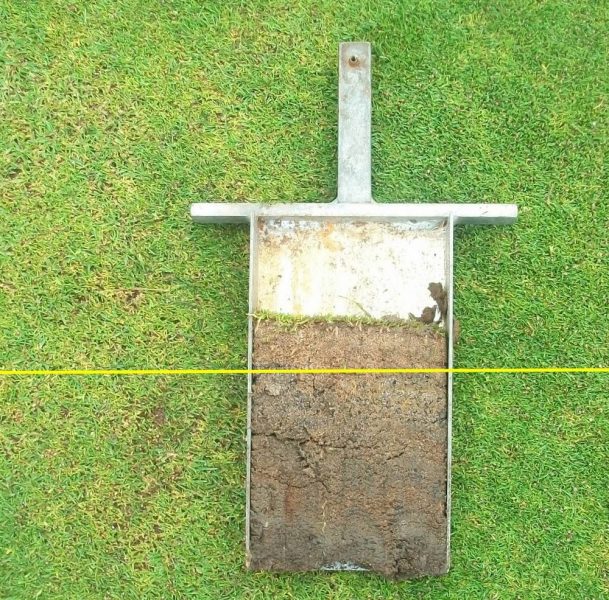
Thatch is the mat of fibre between the grass and soil on your green. Although some thatch (5-6mm) is desirable too much can have  a devastating affect on the  playing surface.

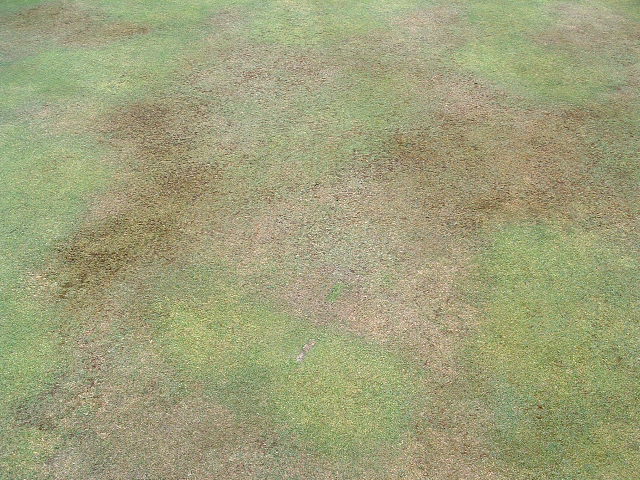
When thatch builds up beyond the optimum level it can quickly cause problems with surface drainage, which in turn can encourage fungal diseases like fusarium patch and this can kill off huge areas of turf if left unchecked. Recovery from such attacks can also be troublesome and expensive.

This tendency to encourage disease is related to thatch’s ability to Read more

Thatch Problems

thatch build quickly on compacted turf

The sward on the majority of UK bowling greens consists of 3 main grass types; various bent grasses (Agrostis), various Fescues (Festuca) and Annual Meadow Grass (Poa annua). Of these, the bent grasses and annual meadow grass are prolific thatch producers.

Thatch consists of dead and dying roots, shoots, leaves, stolons and rhizomes and in comparison to a completely natural setting, it builds up remarkably quickly on fine turf such as bowling greens. This is due to a few factors that are unique to sports surfaces, mainly related to their use and maintenance. Chief among these factors is compaction as we saw yesterday.

Some thatch is good and in fact essential to maintaining the integrity of the surface, but if a layer builds up beyond that (thicker than about 8mm) it can really start to cause big problems.

Flooding, disease, uneven surfaces, Localised Dry Patch, root-break, skinned heads, Read more

Doug’s Spiker

Doug has adapted his rotary mower to save a lot of back breaking work

Straight after my request for guest posts/articles Doug Smith shares this labour saving idea for light aeration of the green. This follows on from Rob’s recent post on hand fork aeration. I’ll let Doug do the talking now:

Hi John, I have been reading your advice  on green Aeration, the one on using a fork, I too have used a fork to
do the job, but only for a short time, I found it took far to long, and very hard work, so I gave it some thought,
and adapted  my lawn mower, [see photo,] I use it on my home lawn, twice a month, and on the Bowls green.
hope this is of some use to your readers.
Regards Doug Smith
Thanks very much Doug for sharing this with us and hopefully it will be the first of many from readers in the coming months.

What bowls green maintenance should be carried out before a game?

Concentrate on minimising lateral grass growth for greater speed and smoothness.

OK, so this is probably a bit late for this year, but keep a note of it for future reference.

This has been a popular question on the site.

The readers who searched on variations of this theme were essentially asking, “What can be done immediately before a game to improve the playing surface?”

Green speed is hampered by excessive thatch build up, which saps some of the momentum of the bowl, so although there isn’t much that can be done about this 5 minutes before the match starts, making thatch reduction and control a major part of the maintenance strategy will help a great deal.

The other major problem in achieving speed is the control of lateral grass growth on the green. This is when grass grows along the ground instead of straight up. The grass plants develop this tendency in order to avoid damage from the mower blades. It’s an evolutionary process; the grass plants that grow this way survive to create more vegetative growth.

So we want to discourage this habit and promote survival of the more upright plants.

To do this we can employ regular grooming, brushing and verti-cutting.

Using the groomer set to 1.5mm above cutting height for the cut immediately before the game will help a lot with this. The groomer attachment on your mower is designed to tease up lateral growth just prior to being cut by the cylinder.

If you don’t have a groomer on your mower you can usually fit a static brush just behind the front roller and this can also do a good job of teasing lateral growth to the upright position prior to cutting if set properly.

Regular verti-cutting will slice through the lateral growth and tease up blades that would otherwise not be cut properly