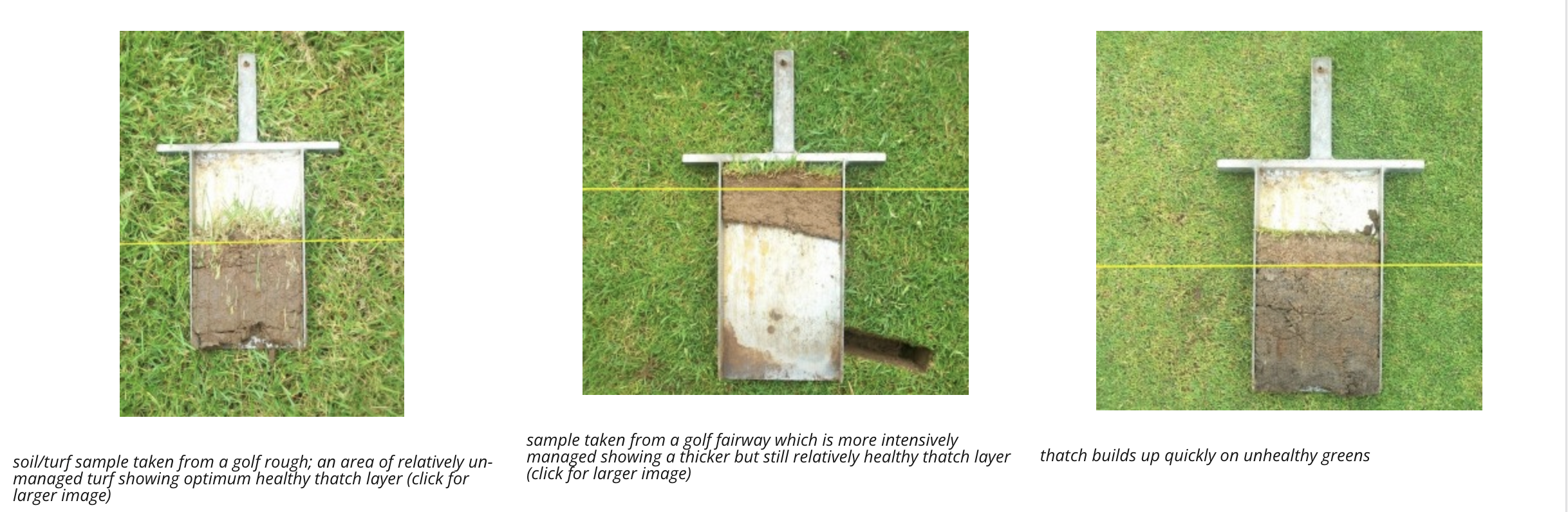
Where grass grows on soil of any type the health of the turf/soil eco-system can be assessed by looking at the thatch layer.
On grass areas where there is little or no human interference in the form of excessive compaction, fertiliser, pesticides and mechanical work (other than mowing) such as in meadows or parks the thatch layer will almost always be at the optimum level for a continued healthy turf/soil eco-system. This is due to the soil/plant relationship being in balance; a strong and sufficiently lively soil microbe population releases nutrition from the thatch layer as it decomposes naturally.
As we move to areas that are subjected to progressively higher maintenance and wear activity, the thatch layer is susceptible to becoming thicker and denser and therefore needs more intensive management if the turf/soil relationship is to be kept in balance.
This can be observed by taking samples from a variety of grassed areas and comparing them to your bowling green’s thatch layer; rough meadows and areas such as the roughs on golf courses being the most natural and healthy areas and greens usually being the least healthy and in need of the most remedial work to keep them right.
When turf is used for bowling or other activities, the soil becomes compacted which is literally the expulsion of air from the soil. This throws the natural balance in the turf/soil relationship and makes it necessary for us to intervene to correct things.It is important to remember that thatch is always being produced and the more vigorous and intensively used and managed the turf is the faster it produces thatch. The desireable fine bent grasses and the common weed-grass, annual meadowgrass are prolific thatch producers.
If we don’t do the right things to correct this effect or indeed if we don’t do them often enough the green can very quickly fall into the circle of decline we looked at in an earlier article.
Recent summers have seen a lot of greens devastated by Localised Dry Patch a disorder that is rapidly becoming the scourge of Bowling Green Maintenance Specialists and Club Greenkeepers a like.
I make no apology for writing about this once again, because in my opinion this issue has the ability to accelerate the decline of many already shaky clubs.
It is also clear that there is a deep misunderstanding of the issue across the bowling community…how do I know this?
Well, on several occasions over the last week I have been confronted with some of the worst examples of Localised Dry Patch I have seen in 30 years; in some cases there is virtually no grass cover left and the green surfaces are unlikely to hold together until the end of the season, but…
Despite that, I am still coming up against two of the most mind boggling situations time after time:
The first is when I am actually demonstrating Localised Dry Patch in action by removing soil samples from affected greens and showing committee members powder dry soil/sand; and they insist that they think the green needs a good top-dressing!
The second is when I get a phone call or email from a club with the same severe LDP problems who have had a recommendation from an “expert” that they need to top-dress their green to over come the problem.
Listen folks; I know this is turning into a bit of a rant but here are a few bullet points that you must remember if your green and maybe even your club is going to survive:
Localised Dry Patch (LDP) is a soil disorder not a disease so it can’t be reversed over-night by any quick fix method regardless of how convincing the salesman is!
LDP has the capability to ruin your green beyond economical repair.
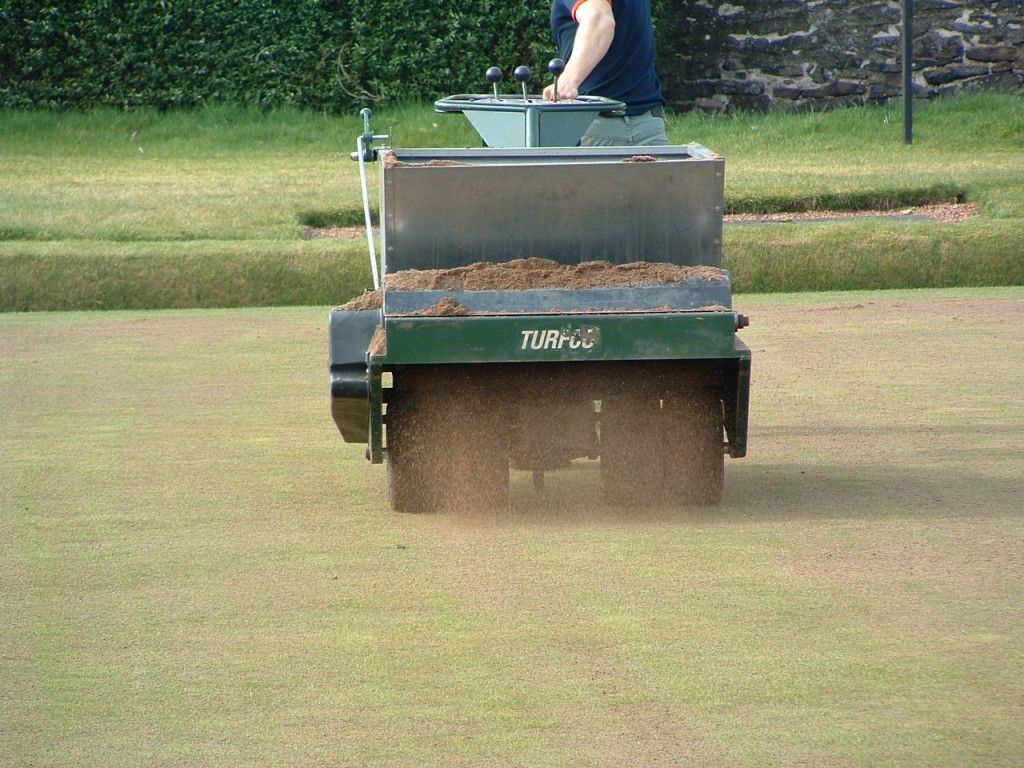
LDP is so common because clubs have habitually thrown tonnes of sand based top-dressings at their greens for decades; the tipping point has been reached, many clubs are now trying to produce bowling surfaces with limited budgets on very high sand content soils; it can’t be done!
More sand will only make the problems worse not better.
So what can be done?
Well currently if your green is affected even mildly by LDP and you are in the process of thinking about an autumn program that includes top-dressing with several tonnes of high sand content top-dressing you are not only damaging your green, but you are also wasting hundreds of pounds.
My eBook Performance Bowling Greens, a practical guide costs less than a bag of fertiliser, so do your green a favour and just buy a copy…its peanuts compared to what you are about to do otherwise.
In the book there is a clear plan for getting over LDP and moving your green to a consistently high performance surface.
You will save a lot of cash by taking a more natural, less abusive approach to green maintenance.
The savings you make could be what saves your club from going under and your green will be on the road to recovery and consistent high performance into the bargain.
If you decide to ignore this, then please take away one message “Stop Dressing”
There aren’t many new bowling greens being built these days but of those that are appearing the initial euphoric rush of the members is somewhat dampened when things seem to immediately start going wrong with their shiny new green.
One of the most common occurrences is that the green sinks, causing bumps and kinks on the surface. I’ve witnessed this first hand, usually after drawing up a specification for the construction of the green and then returning to find that the project architect (bowling green construction is quite often just a part of a bigger project involving buildings etc) and/or contractor has “interpreted” or worse “adapted” the construction specification, has adapted the construction program (sequence), has adopted non-approved methods, or has used “alternative” materials.
In reality it’s usually a mixture of all of these and the main reason that this happens is to save money on the overall project and this usually happens because the project has run over budget on one of the other elements such as the clubhouse or car park. So the most important part of the project suffers due to a lack of good management of the project overall.
Typical details of this are:
Purpose built, pre-cast concrete edge/bank sections replaced with wooden batons and concrete blocks to save money.
Rootzone depth adjusted to save on materials.
Rootzone laid in one layer instead of being built up and consolidated after each layer.
Cheaper spec gravel used for drainage layer and trench backfill.
Wooden batons, blocks, tools, sandwich and drink containers, grease cartridges, drainage pipe off-cuts etc being left in the green after construction is complete.
Now, if your new green has started to sink and is causing difficulty for your club, your architect, again, should have retained a percentage of the project total from the main contractor until a maintenance period has elapsed (usually 12 months) and any snagging lists are completed to your satisfaction; this allows time to pass for mistakes to start to show up.
In addition to this, there should also be a warranty period on the construction and it isn’t unreasonable for this to be 5 years on workmanship and materials.
Finally, there is the fact that despite all of the above being dealt with properly and on time, the very nature of a bowling green is that it will start to settle out in various places, but this should be minimal and will require some level of corrective maintenance to put it right and this is the main reason for the 12 month maintenance period being included in contracts of this nature.
Performance Greens have specific surface attributes
Following on from yesterdays post on Performance Green Properties, the ideal bowling green then, will be uniform in terms of appearance, pace and consistency of play over the whole green and over the season. We will probably see an increase in pace as the summer progresses, but we shouldn’t see too many fluctuations in this pace during an average season.
This consistency is achievable, but only by first getting the green into a condition where it has returned to behaving as one living eco system. This means that the green will demonstrate some very specific attributes. Today we will consider the surface properties of such a green. It will need the following :
Grasses.
The grasses we use to produce the surface will need to demonstrate the following attributes:
Fine leafed with an upright growth habit
Slow re-growth after cutting
Resistance to wear, disease, drought, and cold with a fast recovery rate from wear and damage.
Deep green, uniform colouration
All of the above points us to the finer Bent and Fescue Grasses. So now that we know the kind of surface we need and the kind of grass sward we need in order to achieve this surface we can start to define the ideal growing conditions required by such a sward.
Weeds.
It goes without saying that there should be no weeds in the green surface and by weed I mean any plant life that can disrupt the playing surface. Now, most weeds are obvious because they are broad-leafed and show up in stark contrast to the grass surrounding them. However, there are a few less obvious weeds that can also cause inconsistency on the playing surface such as pearlwort and yarrow and these can sometimes be hard to spot and eradicate, Yellow suckling clover is another difficult weed to deal with.
In addition to the weeds proper referred to above, many greenkeepers who would also consider annual meadow-grass (Poa annua) to be just as bad a weed pest as any dandelion or daisy, but the hard truth is that many greens are so badly infested with this grass that to get rid of it quickly would be to get rid of the majority of the grass sward, leaving the green in a very poor state.
The good news is that the approach required to achieve a performance green outlined in this book will gradually make your green unattractive and unaccommodating to both broad-leafed weeds and weed grasses like annual meadow grass.
Diseases and Disorders
In addition to rogue grasses and weeds the surface can be disrupted by a plethora of different pathogens that directly interact with the grass, usually to its detriment and that of the green surface. These are almost always fungal diseases and some of the more common are fusarium, red-thread and snow mould.
Sometimes confused with diseases are a series of other green defects usually labelled as disorders. These are generally not pathogenic, so don’t directly damage the grass plants, but their effects can be just as devastating to bowling greens. These include slimes and squidge usually associated with acidic soil conditions and the very problematic Localised Dry Patch, associated with thatch, over use of sand and irrigation problems.
Again though, there is nothing to worry about because like we saw with unwanted grasses and weeds in the sward, the conditions required to produce a consistently high performance green will make your green extremely unattractive to these troublesome disorders and diseases.
Green sub-surface requirements for high performance.
The soil we use to support both the structure of the bowling surface and to sustain the grasses required for a high performance surface will require the following attributes:
A strong, stable soil structure that resists compaction and wear.
A healthy, living soil that retains sufficient moisture and nutrients to sustain a healthy sward of fine grass.
A free draining medium able to cope with heavy periods of rain without puddling excessively and which drains quickly after heavy rainfall.
We will keep exploring this and tomorrow I’ll be looking at the sub surface requirements for performance; what goes on beneath?
Compaction is of course one of the big issues in bowling green maintenance and people are always looking for ways to prevent or minimise its occurrence.
Compaction happens to a greater or lesser extent depending on soil type. At the two extremes of this are Clay and Sand.
Think of a potter wetting some powdered clay to throw a pot and you can immediately picture the compaction and drainage properties of this soil type; it compacts very well when wet and clay pots don’t allow drainage at all; and when clay soil is wet this is pretty much the case under your green too. Clay is a very good moisture and nutrient retainer.
Now imagine running on to the upper reaches of the beach, up near the dunes and it’s hard to imagine how this highly mobile sand could ever be compacted. Due to the particle shapes which are round, there is a huge amount of air space between particles which doesn’t allow for any level of compaction.
The above examples are, I think, the reasons that clubs have been all too eager to jump on the sand band wagon over the last few decades; more sand seems to equal better drainage and lower compaction.
The best bowling green soil lies somewhere between the two and is a sandy loam as discussed here.
So although individual actions like foot and maintenance traffic can be said to cause compaction, the underlying soil holds the real answer.