Home » Archives for John » Page 2

Author: John

Master Greenkeeper John Quinn is the author of Performance Bowling Greens, and several other titles on Greenkeeping, Club and Business Management.

Fusarium

Turf Disease Triangle

Managing diseases like fusarium patch can be a challenge for bowling greenkeepers striving for healthy, high-performance turf. While fungicides provide some relief, long-term reliance can weaken natural defences and disrupt soil health. Emerging research highlights the value of PotSi as a sustainable alternative to bolster turf resilience. By strengthening cell walls, enhancing stress resistance, and activating natural defence mechanisms, potassium silicate offers a proactive approach to reducing disease severity and recurrence. Discover how integrating this innovative solution into your maintenance programme can support greener, more sustainable greens.

Read more

Annual Meadowgrass

How to painlessly transform greens from Poa annua to bent/fescue

Transitioning your green from Poa annua to bent/fescue is not only critical to achieving a Performance Bowling Green, but is actually a realistic goal. The spongy, soft turf associated with annual meadow grass is less than ideal for bowls. Common wisdom says that this can't be done without major disruption and that even after it is achieved it wont last. This article explains in detail how to undertake the transition of your green from Poa annua to bent/fescue turf and dispels the myths about stressing Poa. This is the way to change your green permanently and without fuss. It will also save your club money on maintenance, so what's not to like?

Read more

Silicon is an indispensable element in fine turf management, offering a range of benefits from strengthening plant cell walls to improving nutrient uptake and enhancing stress resistance.

Focus on Silicon: A Greenkeeper’s Perspective

Timely applications of PotSi have been shown to be particularly effective in preventing the onset of fungal diseases. For example, applying PotSi at the early stages of a Dollar Spot outbreak can significantly reduce disease severity by fortifying the turfgrass against the pathogen. This proactive approach not only mitigates disease impact but also reduces the need for chemical fungicides, promoting a more sustainable turf management strategy .

Read more

Bowls Green Soil Texture part 3

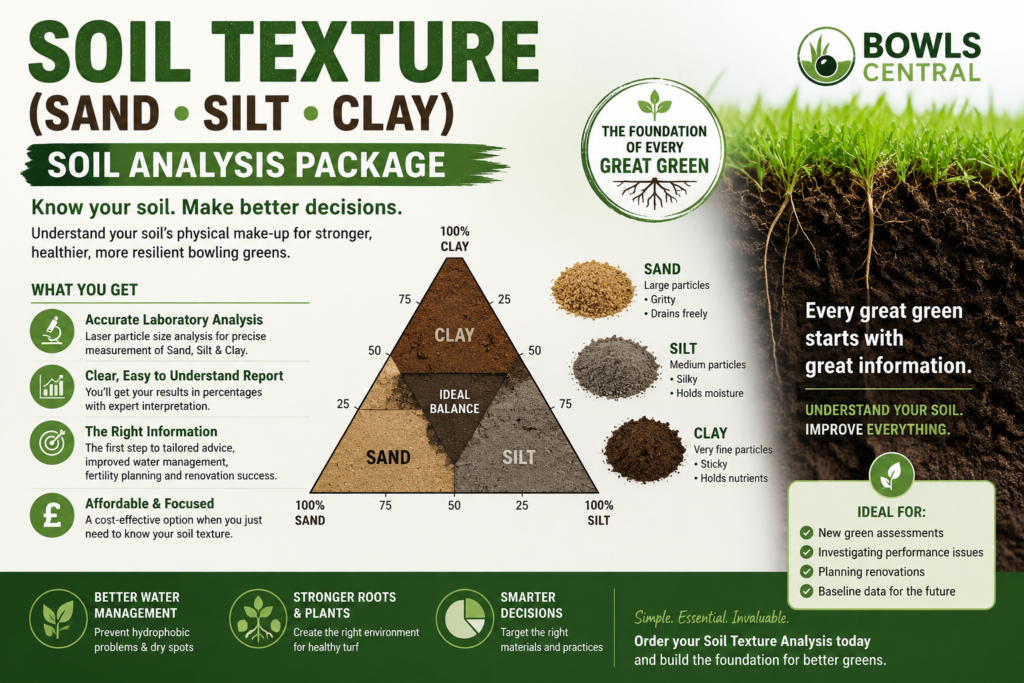
In the first part of this series we discovered that the ideal bowling green soil (or rootzone) will be 50% space, 5% organic matter, with the remainder (45%) being made up of mineral matter, namely Sand, Silt and Clay. These are the 3 universal mineral components of soil.  Part 1 finished with an explanation of the soil fractions, 5 of which were sands of varying sizes.

In part 2 we found out a little bit more about sand and it's behaviour as a drainage medium and we discovered a little more about how soils are formed. We finished by looking at the importance of sand particle shape and size in bowling green rootzones.

Read more