The autumn is traditionally a busy time for bowling green contractors, greenkeepers and club officials as they decide, plan and carry out the autumn renovation works on the green before putting it to bed for the winter.
Now have a look back over that last paragraph; if you didn’t wince at least twice, then it’s possible that you are about to embark on a program of work that will actually harm your green.
It probably won’t be dramatic like the sudden death of your green for ever, but it will probably have a negative impact on the future of your green’s ability to be presented for play consistently well, and maybe even on your club’s chance of survival in these harsh economic conditions.
I often talk about close mowing here on bowls central and don’t usually recommend a cutting height of less than 4.5mm even in perfect growing conditions. Of course the mower blades will have been set higher during the recent very dry and very hot weather to allow the plants to retain more leaf area and therefore more moisture. An understanding of turf grass growth characteristics is important in helping you to make the correct maintenance decisions.
Crown
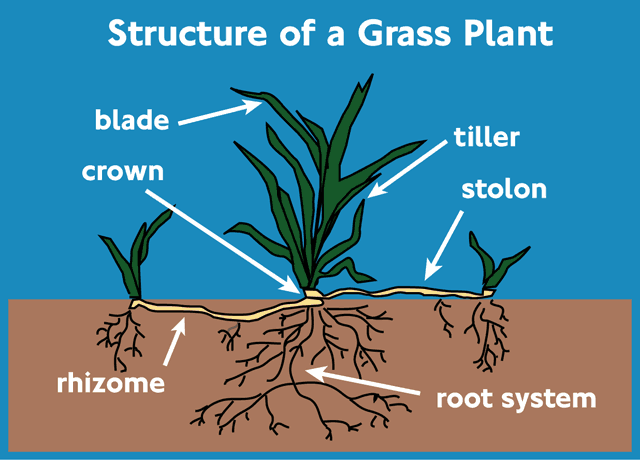
Another reason for avoiding excessively close mowing is the irreversible damage that can be done to the grass plant, especially if the crown is damaged. The plant can survive a lot of trauma as long as the crown remains intact, so great care should be taken to avoid scalping the green too close.
In my recent post about turf grass shoot structures I mentioned the plant stem as one particular shoot structure used by turf grass plants. You can think of the crown of the grass plant as a stem that has been squashed down, concertina style to the ground. All of the internodes where leaves arise are stacked alternately into a very compact stem that barely rises above the soil surface. This critical part of the grass plant includes the upper stem apex and the same bud meristems (where new shoots arise) as the longer stems we looked at before, only in this form the nodes are all tightly stacked with no elongation of the internodal area to speak of. Finally there are the lower meristematic nodes and it is here that the plant can initiate new roots and shoots.
Lateral Shoots
New lateral shoots can be initiated from vegetative meristems or buds in the base of leaves or from stem nodes, rhizomes or stolons. These lateral shoots can be tillers, stolons or rhizomes depending on species and conditions.
Intravaginal Growth
Young stems can grow out from the basal sheath of the the grass leaf and this is called intravaginal growth.
Tillers
The main turf grass plant characteristic that allows the formation of dense sports turf is that of tillering. Tillers originate intravaginally from the plant stem and can be encouraged by
mowing below 30mm
ready availability of Nitrogen
good sunlight levels and reduced shade
good carbohydrate reserves in the plant (strong photosynthesis activity)
Some grass species employ tillering exclusively and therfore form a bunch type growth habit. These include colonial bentgrass, hard fescue, sheep’s fescue, chewings fescue, annual ryegrass, perenneial ryegrass and annual meadowgrass.
Extravaginal Growth
Extravaginal growth is when young stems grow vegatatively by pushing through the lower part of the basal leaf sheath. This type of growth is split into two main groups:
Stolons
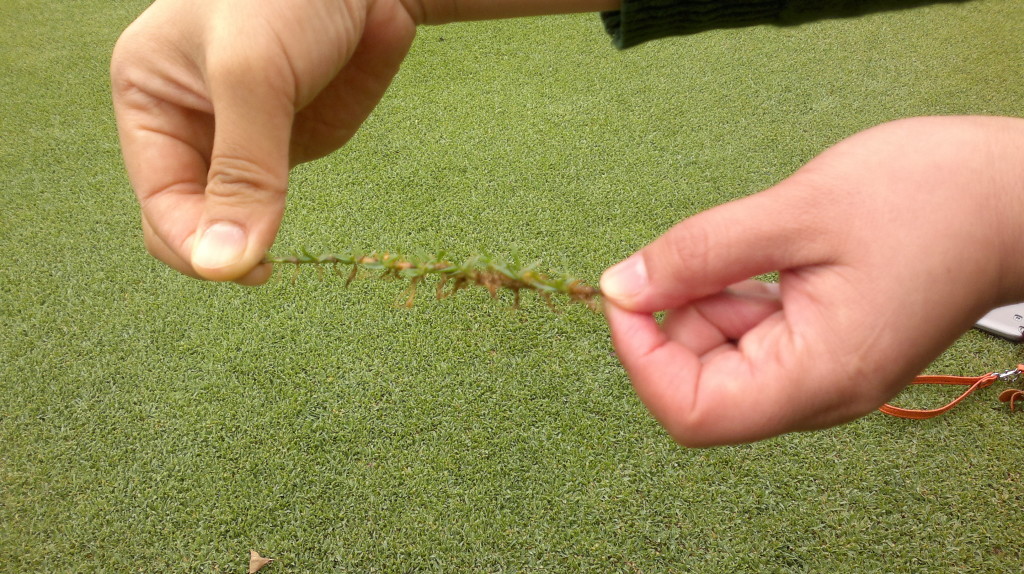
A stolon is a secondary shoot that grows extravaginally above ground with considerable elongation of the stem horizontally.
this allows the plant to initiate a spreading (sometimes called creeping) growth habit.
creates a secondary carbohydrate reserve for emergencies
creates opportuities for spreading vegatively as each node on the stem can produce new daughter plants by producing roots and shoots.
increases the knitting together and strength of the turf.
Common stoloniferous grasses include velvet bentgrass and creeping bentgrass
Rhizomes
Rhizomes are similar to stolons except that they break through the leaf basal sheaf below ground and spread by means of elongated underground lateral stems. This characteristic:
gives the plant a strong lateral, spreading growth habit.
adds to turf strength and integrity
provides a secondary carbohydrate store for emergency growth requirements
helps turf to have a strong recuperative potential from wear and injury
allows for improved dormancy survival after heat and drought
initiates new plants at stem nodules in the same way that stolons do except underground.
Rhizomatous grass plants grow strongly when conditions provide for their optimum temperature ranges (150-240C for cool season and 270-350C for warm season grasses). Long day length, high light intensity and lower nitrogen availability also favour their success.
To provide the thickening of turf density the rhizome must turn upwards towards the surface to allow for new shoots to be initiated and this is favoured by light exposure (e.g. by aeration, brushing etc), low CO2 levels in the soil (aeration), heat stress (not over watering), shorter photo period (day length) and good nitrogen availability.
The rhizomatous grasses include many of the red fescues and smooth stalked meadow grass.
Integrated Secondary Lateral Growth Habits
Many of the most commonly used warm season turf grasses employ stolons and rhizomes to create a very vigorous and tight knit turf that recuperates well from stress and provides high wear tolerance. These include many of the Bermuda, Zoysia and Seashore Paspallum grasses.
Inflorescence
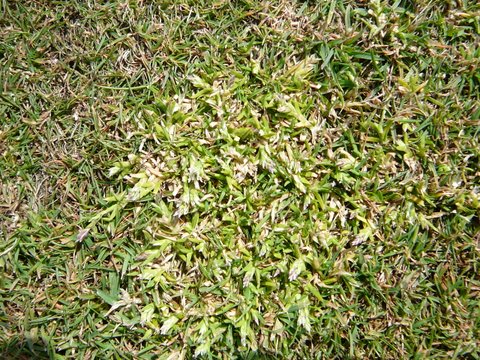
Annual Meadowgrass inflorescence on bowling green (photo by S Kennerley)
This is the structure put up by the plant in order to create and spread its seed. It is an erect flowering structure and the seeds are formed on individual spikelets of it. Shortenting day length and cooling temperatures initiate this in cool season grasses. This isn’t usually a feature of quality turfgrass as it depends on grass being allowed to grow naturally to its full height, but it can be seen in turf on annual meadow grass in the spring and early summer.
If you have anything to add or any questions please leave a comment or drop me a line.
Since I did a little bit of an introduction to turf grass botany yesterday by talking about cool and warm season grasses, there has been further interest from readers in exploring turf grass botany.
There’s no better place to start than at the beginning, so today we will look at the basic shoot structure of the grass plant. Of course there is a lot of variation between species in how these structures appear but the following is a broad overview of turf grass plant shoot structures.
Shoot
This is the basic functional unit of the plant and consists of a short stem with leaves appearing alternately from nodes along the stem.
Stem
The stem is the main trunk of the plant that can take the form of a crown, which is a kind of bunched up stem where all of the leaf producing nodes are stacked one on top of the other or of an elongated stem (stolon or rhizome) that grows laterally either on or below the soil surface with widely spaced internodes from which new shoots and roots can appear. Lastly it can appear as a long upright stalk with widely spaced internodes (leaf producing points) ending in an infloresence/flower which is called a culm; more commonly called a seed head. The main functions of the stem are:
sites of buds where new shoots or roots can be initiated.
the movement of water, nutrients and food (carbohydrates) between the roots and the leaves.
storage of food for emergencies such as drought or injury.
Nodes
These are the bulbous points on the stem where leaves, roots or branches of the stem are initiated. These nodes are key to the recovery of turf grass from wear and tear and other natural stresses such as heat and drought, insect and disease injury. They are key structures in determining the recuperative potential of the turf grass plant.
Internode
The internodes are the sections of the stem between nodes and these sections rather than just being the bits between the all important nodes, are key areas of activity in the plant. This is where the translocation (transport) of water, nutrients and already photosynthesised food (carbohydrate) occurs.
A key point to note here is that if you cut through the stem, new growth will be stimulated from the immediately adjacent nodes on each side of the plant to form new shoots or roots depending on their position on the plant. This is why frequent mowing is so important in producing a dense turf.
Leaf
The grass leaf is the part we think of as the blade (although that has a more specific meaning in botany) and grows laterally out of the stem at a node. The leaf consists of an upper blade which is flattened and a basal sheath which encircles the stem at the node from which it arises. The leaf is the key food producing structure of the plant as it contains chlorophyll, the green pigment responsible for the capture of light energy from the sun. The leaf is a hive of food producing activity, being the main site of photosynthesis in the grass plant. It is the leaf that when combined with many thousands of others, forms the turf that we need for bowling.
Blade (leaf)
Rather than referring to the whole leaf, the blade is actually the flattened portion of the leaf furthest from the stem, although in species such as Festuca (Fescues) the flattening is barely perceptible.
Sheath (leaf)
This is the tubular portion of the leaf surrounding or wrapping around the stem at a node. Usually referred to as the basal sheath, it contains some chlorophyll which gives it a green colour.
So that’s the basic structure of the turf grass plant in very brief terms. Next time I will dig a little deeper and look at how grass plants actually grow.
As always, if you have anything to add, observations or questions just add a comment below or drop me a line.
When I set out to write my book, Performance Bowling Greens, it made me think about the main obstacles to success encountered by many of the bowling clubs I visit and in many ways it comes down to what can only be described as Common Sense versus Commerce. The 4 biggest obstacles I encounter again and again are as follows:
Desperation Mode; or a state of mind that permeates a club when nothing they do seems to yield the results they crave.
Lack of Consistency; which is direct result of the 1st obstacle, and is when the club repeatedly changes its approach to maintenance because it basically has no faith in any of the maintenance models it encounters.
Tradition; although a lot of the traditions in question are not that old.
Greenkeeping Myths.
The reasons for the problems I have just mentioned are mainly to do with the need that exists in every
industry to have companies or people who can supply materials and equipment in order for the work of that industry (in our case greenkeeping) to go ahead. So you see as greenkeepers or bowling clubs we are part of a commercial chain that needs constant lubrication in order to keep going. The end result of that process is the pressure put on all of us to try new things, new machines, new fertilisers, new chemicals etc. And of course this isn’t a bad thing in itself, because if it wasn’t for this continual process we wouldn’t have any of the tools we need to continue maintaining our green. The trouble comes when laymen or greenkeepers lacking confidence in their abilities are constantly bombarded with new “stuff” by “experts”. This leads to “new traditions” which lead to a lack of consistency, which leads to poor results, which leads to desperation for a solution and desperate people are willing to believe anything, so even myths can take on the appearance of common sense.
In Performance Bowling Greens I will be detailing a more measured and calm approach to bowling green maintenance based on scientific fact, a deep understanding of nature and the interaction between turfgrass and soil. An approach, in fact a full program you can follow to ensure that your green performs to a very high standard at a reasonable cost.
And its there that we will pick up the story tomorrow, as I will be looking at how heavily the future of bowling depends on the ability of clubs like yours to deliver consistent high performance on what can only be described as a shoestring budget.
Slime on bowling green turf and squidge are disorders of turf that can be both unsightly and hazardous for players as they can both make the surface slippery.
Although they don’t cause damage to the turf as such, they are signs of underlying problems with your green.
The conditions that attract these disorders to your green are excessively wet and spongy turf, usually due to excessive thatch. The soil will usually also be very acidic as a result of anaerobic soil/turf.
The medium to long term solution is to deal with the thatch and you can get the low down on that here.
Immediate and on-going aeration will help a lot to get the process of recovery started, but this has to be part of a concerted program of work to deal with compaction, thatch and generally poor soil conditions.
The question of liming acidic soil comes occasionally, but this is not recommended as broadcasting of lime on fine turf can lead to immediate outbreaks of fungal disease and in any case it usually isn’t needed.
As soon as you start to get some oxygen back into the soil by relieving compaction and dealing with the wet and usually smelly, anaerobic thatch, the soil will start to “sweeten” again.
However there is one little lime based trick you can use to clear the green of the odd patch of slime to allow a match to go ahead and its detailed here.
The main issue is to start to follow a Performance Greens maintenance program to get over the conditions that caused the problem in the first place.